
Capitol 101 — Qualified Opportunity Zone investment in downtown Fremont
Your last 2026 window for tax-advantaged downtown Fremont real estate.
Defer the federal tax on your 2026 capital gain. Quarterly distributions from Year 3. Federal capital-gains tax on appreciation excluded at the 10-year hold.
Year 3: quarterly cash begins. Year 4: investor exits.
- Year-3 cash-on-cash
- 8.10%
- Equity multiple
- 2.04×
- Stabilized NOI
- $7.57M
- Minimum investment
- $250K
Offering documents released after accreditation verification.
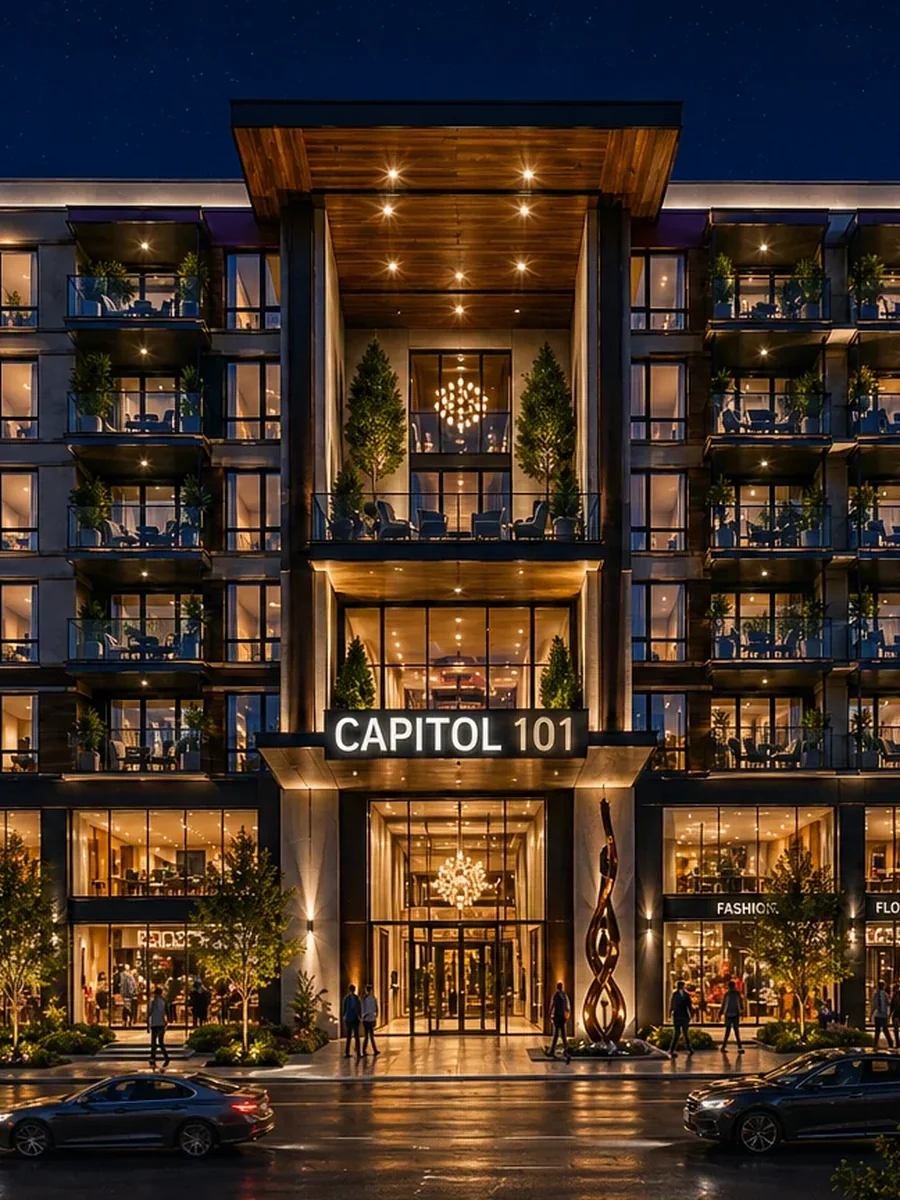
A transit-oriented anchor on Capitol Avenue.
3411 Capitol Avenue — three minutes from Fremont BART, fifteen from Tesla, twenty-five from Silicon Valley. LEED Gold target. Built to be owned and operated for decades.
Location
3411 Capitol Ave, Fremont, California 94538. The parcel sits within a designated Qualified Opportunity Zone confirmed on the current Census tract QOZ map. Three minutes to Fremont BART.
Project snapshot
- 126 luxury apartments
- 14,000 sq ft of ground-floor retail
- Seven floor plans named for Fremont neighborhoods
- Two-level podium parking · EV-ready
- LEED Gold target · transit-oriented · ESG-aligned
- Target delivery: 2028
Key terms
- Minimum investment: $250,000
- Offering type: Private placement · accredited investors only
- Target hold: 4 years to projected exit
- Distributions: Quarterly from Year 3
See what you walk away with.
Two paths, same project. Enter your investment and your projected annual return — see both the 4-year exit outcome and the 10-year exit outcome with the QOZ federal capital-gains exclusion applied.
Sell at stabilization
- Gain on equity
- —
- Federal cap-gains tax (23.8%)
- —
- Net after federal tax
- —
QOZ federal exclusion does not apply — the 10-year hold is required.
Hold for the federal exclusion
- Gain on equity
- —
- Federal cap-gains tax (QOZ exclusion)
- $0
- Net after federal tax
- —
Your QOZ federal tax savings vs. taxable hold: —
Illustrative projection only. Not tax, legal, or investment advice, and not an offer of any security. The model assumes annual compounding at the user-selected return rate and federal long-term capital-gains tax at 23.8% (top LT rate + NIIT) on the appreciation at exit, with the QOZ federal exclusion applied to the 10-year-hold path only. Actual returns depend on project performance and individual tax circumstances. Past performance is not indicative of future results. Investments in private real estate involve substantial risk including possible loss of principal and are illiquid. State tax treatment varies. Available only to verified accredited investors. Any offer made only by means of a Private Placement Memorandum.
Three tax effects, one decision.
Defer
Delay federal capital gains tax on the reinvested gain until the earlier of the QOF sale or December 31, 2026 — whichever comes first. The gain recognition is pushed out, the cash stays working.
Reduce
Historical basis step-up (5-year 10% and 7-year 15%) has largely phased out for new investments after the December 31, 2021 cutoff. Congress has been actively considering QOZ 2.0 extensions; consult current tax counsel.
Eliminate
Hold the QOF investment for at least 10 years and pay zero federal capital gains tax on the appreciation of the QOF interest itself. This is the single largest tax benefit in the US real estate code today.
QOZ, briefly.
The Qualified Opportunity Zone program was created by the Tax Cuts and Jobs Act of 2017. Its aim was simple: pair the US capital-gains tax code with the capital stack of underinvested communities. Investors with recently realized gains could reinvest those gains into Qualified Opportunity Funds (QOFs), and in exchange receive a layered package of tax deferral, basis adjustment, and — at the 10-year mark — complete elimination of federal capital gains on the QOF appreciation.
Zones were designated in 2018 by each state's governor, drawn from low-income census tracts defined by the Treasury. Once a tract is designated, it retains QOZ status through the end of 2028 regardless of later changes to its underlying economics. The total designated pool covers roughly 8,700 census tracts nationwide — including several in downtown Fremont.
By 2026, the program has matured. The original deferral-to-2026 window is now operative for late-stage reinvestors, the basis-step-up incentives have largely sunset, and the 10-year elimination benefit remains intact and central. Congress has repeatedly introduced QOZ 2.0 legislation that would extend the reinvestment window and restore the step-up — investors should verify current rules with qualified tax counsel.
QOZ is a federal program. California does not fully conform to federal QOZ treatment at the state level, which means California-resident investors should plan for state-level gain recognition on a different timeline. This is a meaningful detail, not a footnote.
Who QOZ is built for.
- Capital-gain holders. Investors who've just realized a large gain from stock sale, business sale, crypto, real estate, or an M&A event — and want to defer the federal tax while redeploying the capital.
- Long-horizon US taxpayers. Real estate has a 10-year clock. QOZ rewards patience — the biggest benefit (zero federal cap gains on appreciation) requires a minimum 10-year hold.
- Accredited investors only. QOZ offerings at Fremont Developers are limited to accredited investors who confirm status on the inquiry form.
- Comfortable with illiquidity. QOFs are illiquid by design. Your capital is working in real estate for a decade.
- Bay Area believers. The 10-year appreciation is where the real money is. You have to believe the underlying asset will grow.
180 days from gain realization.
From the date you realize a capital gain, you have 180 days to invest the equivalent amount of that gain into a Qualified Opportunity Fund. Miss the window, and the QOZ benefits are no longer available for that gain.
What starts the clock
- Sale of appreciated stock or crypto
- Sale of a business or business interest
- Sale of real estate (non-1031 gain)
- Capital gain distributions from pass-through entities (K-1 timing rules apply)
Special rules apply to gains reported via K-1 partnership allocations — the 180-day clock can start either on the date of the underlying sale or on the last day of the partnership tax year. Consult tax counsel.
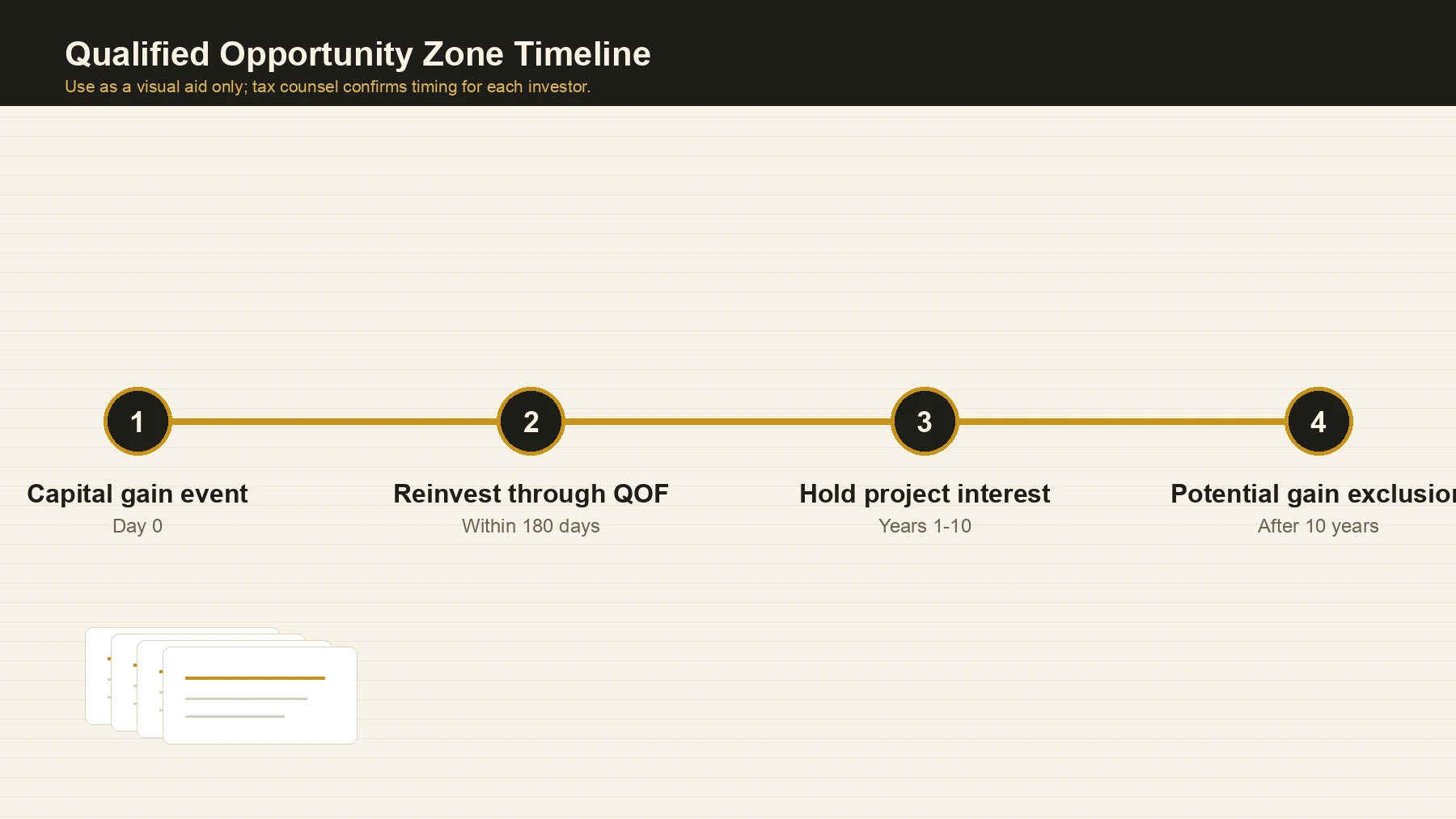
From gain to 10-year exit.
Stock, business, crypto, or real estate sale.
The 180-day clock starts at the gain realization date.
Capital subscribed into the Qualified Opportunity Fund.
QOF invests in Capitol 101 as QOZB-qualifying business.
0% federal cap gains on appreciation.
Simplified flow. Actual documents include substantial-improvement tests, 90% asset tests, reasonable working capital safe harbors, and annual form filings — all managed at the fund level.
Five steps to subscribed.
-
i.
Identify the gain
Confirm the realization date, gain amount, and character (short-term vs long-term). Bring your CPA into the loop early.
-
ii.
Verify accreditation
Verification via investor questionnaire with supporting documentation. Valid 90 days.
-
iii.
Receive offering documents
PPM, Operating Agreement for Tranquil Path LLC, Subscription Agreement, and the QOF investor questionnaire.
-
iv.
Subscribe within the 180-day window
Execute subscription docs and wire capital into the QOF escrow before the 180-day deadline from your gain realization date.
-
v.
Annual compliance and reporting
Form 8997 filing each year. Quarterly QOF reporting. Annual K-1. We manage the fund-level compliance; you handle Form 8997 with your tax preparer.
This is not tax advice. Consult a qualified CPA or tax attorney. Your specific benefit depends on your gain basis, realization date, holding period, entity structure, and state tax regime. California does not fully conform to federal QOZ treatment — California-resident investors face state gain recognition on a separate timeline. We will provide introductions to experienced QOZ tax advisors on request.
Questions, answered.
What kinds of gains qualify for QOZ reinvestment?
Most federal capital gains qualify: long-term and short-term gains from sale of stock, business, crypto, real estate, partnership interests, and certain K-1 distributions. Ordinary income does not qualify. Consult your CPA to confirm.
Do I have to reinvest the full gain?
No. You can reinvest any portion of the gain. The amount reinvested into the QOF receives QOZ treatment; the balance is taxed normally. Many investors reinvest the portion they want to defer and keep the rest liquid.
Is Capitol 101 definitely in a QOZ?
Yes. 3411 Capitol Ave, Fremont sits within a Census tract designated as a Qualified Opportunity Zone in 2018. That designation is preserved through 2028 regardless of intervening economic changes to the tract. We will share the specific tract designation in the offering documents.
Can I invest from a retirement account?
Qualified retirement accounts (IRA, 401(k)) generally don't generate capital gains, so the reinvestment mechanism doesn't apply from these accounts. QOZ is a mechanism for after-tax capital with a recently-realized gain.
What happens if I sell before 10 years?
You forfeit the elimination benefit on QOF appreciation. The deferred gain is still recognized. Early exit generally makes QOZ economically unattractive relative to alternative deployments.
What paperwork do I need to file with my taxes?
Form 8949 to report the original gain and elect deferral. Form 8997 annually to maintain QOF investor status. Your CPA handles these filings using the K-1 and QOF statements we provide.
How is Capitol 101 valued at the 10-year mark?
At sale or refinance, the market value determines the appreciation subject to the 0% federal cap gains benefit. The QOF interest itself can be valued on a basis step-up to fair market value at year 10 for elimination purposes — your tax advisor runs the mechanics.
What if I'm not sure my capital gain is still within the 180-day window?
Call us. The window depends on the specific realization event — and K-1 gains have extended deadline options. We can point you to QOZ tax counsel who can confirm your window quickly.
Get the PPM & subscription documents.
2026 allocations are limited and filling. Tell us about your situation — we'll release the Private Placement Memorandum, the subscription agreement, and the Capitol 101 underwriting deck after you self-confirm accredited status. We respond within one business day.
This is not tax, legal, or investment advice. The tax benefits of Qualified Opportunity Zone investment depend on individual circumstances including your capital gain realization date, holding period, and state of residence. California does not fully conform to federal QOZ treatment. Consult a qualified tax advisor before investing. QOZ designations and rules are subject to change by act of Congress or administrative action. This website does not constitute an offer to sell or a solicitation of an offer to buy any securities. Any such offer or solicitation will be made only by means of a Private Placement Memorandum delivered to verified accredited investors. Securities are offered through Tranquil Path LLC under Regulation D Rule 506(c). Investments involve risk, including possible loss of principal. Past performance is not indicative of future results.