Category: Senior Living

  • Understanding California RCFE Licensing: What Families Should Ask

    Understanding California RCFE Licensing: What Families Should Ask

    Senior Living

    Understanding California RCFE Licensing: What Families Should Ask

    A plain-English guide to California’s RCFE licensing regime — what the license means, what questions to ask on every tour, and how to verify a community’s inspection history.
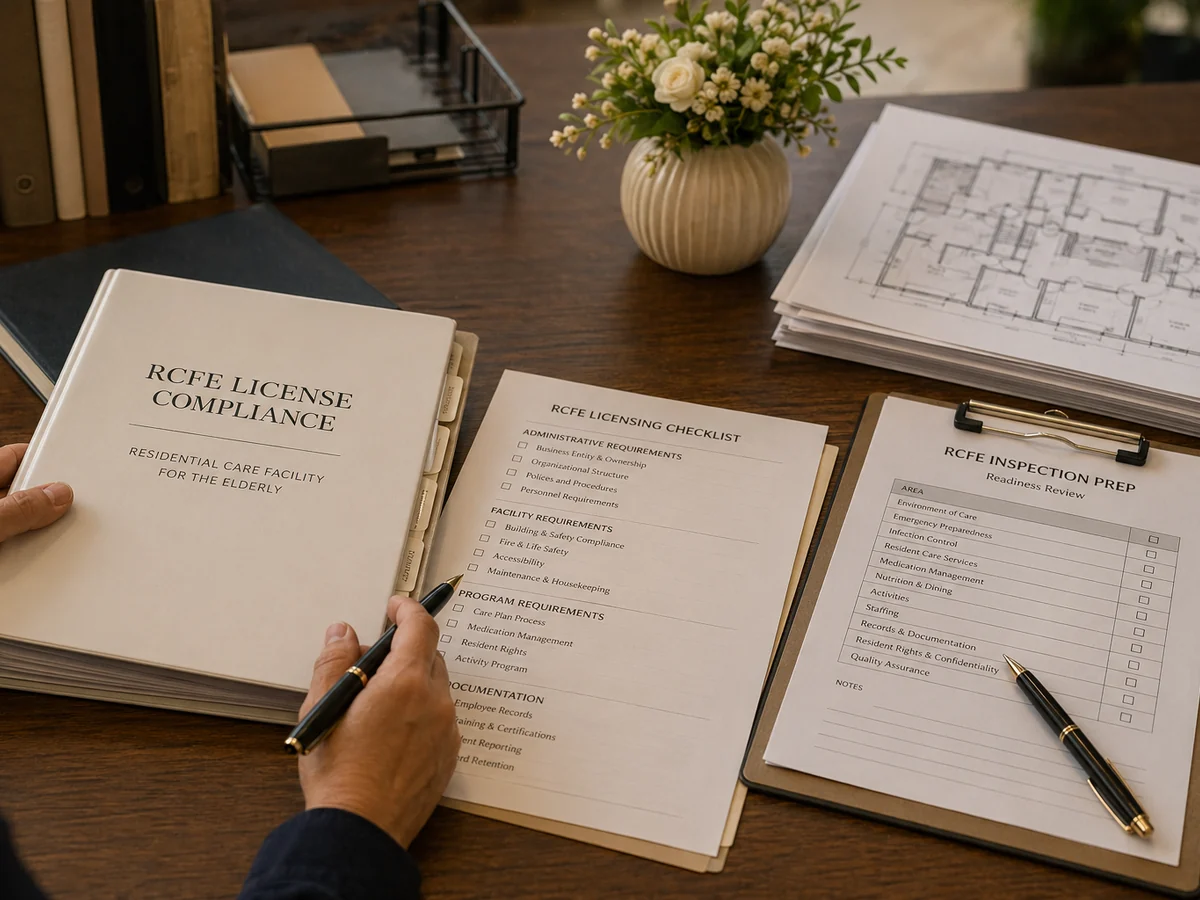
    California RCFE licensing guide for families

    What RCFE stands for and what it covers

    RCFE stands for Residential Care Facility for the Elderly. In California law, it is the specific license category that governs what most people call “assisted living” and many “memory care” communities. If you are touring a senior living community in California and the staff describe it as assisted living or memory care, the underlying license is almost certainly an RCFE license. The category is defined in Title 22 of the California Code of Regulations and administered by the California Department of Social Services, Community Care Licensing Division (CCL).

    An RCFE license authorizes a facility to provide non-medical care, supervision, and support services to residents age 60 and older (with limited exceptions for younger residents with age-related conditions). “Non-medical” is the operative phrase. An RCFE can provide assistance with activities of daily living — bathing, dressing, grooming, mobility, medication assistance — along with meals, housekeeping, social activities, and, when appropriate, memory care. It cannot provide skilled nursing care except under specific waiver categories discussed below.

    RCFE vs SNF vs CCRC

    The vocabulary of senior living is confusing enough that families routinely tour one license category thinking they are looking at another. The three you are most likely to encounter in California:

    RCFE (Residential Care Facility for the Elderly). Non-medical assisted living and memory care. Residents are generally ambulatory or use walkers or wheelchairs independently. Licensed by CA DSS Community Care Licensing. This is what most “assisted living” and “memory care” communities are.

    SNF (Skilled Nursing Facility). A medical facility providing 24/7 skilled nursing care, including wound care, intravenous therapy, and post-acute rehabilitation. Residents are typically non-ambulatory, bedridden, or require substantial medical interventions. Licensed by the California Department of Public Health under a different regulatory regime. Often called “nursing homes.” Medicare and Medi-Cal will pay for SNF care under certain conditions; they will not pay for RCFE care, which is private-pay.

    CCRC (Continuing Care Retirement Community). A community that offers a spectrum of care levels — independent living, assisted living, and skilled nursing — on a single campus, typically under a long-term contract in which residents pay an upfront entrance fee. CCRCs are regulated separately under California’s Continuing Care Contracts Act, in addition to whatever individual RCFE or SNF licenses the component units hold. Velora’s communities are RCFE communities, not CCRCs.

    Which category you actually want depends on your loved one’s current care needs and how those needs may evolve. For ambulatory seniors who need help with some activities of daily living and benefit from social and cognitive engagement — which is the majority of senior-living entrants in California — the RCFE is the correct fit.

    If the staff can’t immediately tell you what license category the facility holds, the tour is already over. Ask as the first question.

    Who issues the license

    California Department of Social Services, Community Care Licensing Division (CCL) issues all RCFE licenses in the state. CCL operates regional offices that cover groups of counties; every RCFE has a named Licensing Program Analyst (LPA) assigned to it, and that analyst is the regulatory counterpart the administrator works with on inspections, citations, and corrective actions.

    The license application process is substantial. Prospective RCFE operators submit a formal application that includes the proposed facility’s physical plan, staffing plan, program statement (which describes the care services to be offered, resident admission criteria, and operational policies), fire clearance from the local fire authority, and administrator qualifications. The administrator must complete a state-approved 80-hour RCFE administrator certification course and pass a competency exam. Site inspections follow. Initial licensure typically takes 9 to 18 months from application to license issuance — longer in some regions.

    What the license allows a community to do

    A standard RCFE license authorizes admission of ambulatory residents 60 and older, provision of non-medical care and supervision, medication assistance (distinct from medication administration, which is SNF-level and requires different licensure), dementia care under specific conditions, and coordination with outside licensed health-care providers for medical services. It does not authorize 24-hour skilled nursing, intravenous therapy, or the admission of residents who are consistently bedridden or who require continuous nursing-level intervention.

    Two waiver categories meaningfully extend what an RCFE can do. The hospice waiver and the non-ambulatory waiver.

    Hospice waiver — what it means for aging in place

    The hospice waiver is, for many families, the single most important licensing detail. Without a hospice waiver, an RCFE resident who enters hospice care — that is, who is certified by a physician as having a terminal condition with a prognosis of six months or less — must typically be discharged from the RCFE to a different care setting (SNF, home hospice, or inpatient hospice).

    An RCFE with a hospice waiver, in contrast, can continue to provide care and supervision to a resident who has entered hospice, with the clinical hospice services provided by a licensed hospice agency working alongside the RCFE staff. The practical effect: a resident who has lived in the community for years, developed relationships with staff and other residents, and considers the RCFE their home can remain in that home through the end of life. This is what families mean when they talk about “aging in place.”

    Velora operates under hospice waivers where permitted; this is a deliberate choice at the community level and one we strongly encourage families to ask about on any RCFE tour. If a community cannot accommodate hospice-level care, your loved one will eventually need to transition out, and that transition — for residents with dementia or advanced frailty — can itself be destabilizing.

    Non-ambulatory and bedridden allowances

    The baseline RCFE license admits only ambulatory residents. But a resident who ages in place may progress to non-ambulatory status over time; the question is whether the community can retain that resident or must discharge them. California permits RCFEs to apply for non-ambulatory exceptions, which — in conjunction with fire-clearance updates to confirm the building can safely evacuate non-ambulatory residents — permit the community to continue caring for residents who have become non-ambulatory.

    A separate waiver permits RCFEs to retain bedridden residents under specific conditions (typically in connection with hospice status or with time-limited medical recovery). The specific allowances vary by community and by the community’s fire clearance and physical plant; ask the administrator directly what conditions the community is authorized to accommodate and for how long.

    The questions families regret not asking are not about cost. They are about what happens when Mom’s needs change — and whether the community can adapt, or whether Mom has to move.

    How to check a community’s inspection history

    Every California RCFE is inspected periodically by CCL. Inspection reports, citations, and corrective action plans are public records. Families can look up any RCFE’s inspection history through the CCL facility search on the California Department of Social Services website (the public tool is published at cdss.ca.gov, under Community Care Licensing). Search by facility name, city, or license number.

    What you will see: the facility’s current license status (active, provisional, revoked), the most recent inspection date, any citations issued (categorized by severity), and the facility’s responses and corrective action plans. Citations happen at most facilities — some are administrative (incomplete records), some are operational (a minor dietary or staffing deficiency), and some are substantive (a serious incident that resulted in harm). The question is not whether citations have occurred; it is the severity pattern, the frequency, and the facility’s responses.

    A community with occasional administrative citations and strong corrective action responses is normal. A community with a pattern of substantive citations (Type A citations for serious resident harm, or repeated Type B citations for the same issue) is a red flag. Families should never rely on a facility’s self-representation of its inspection history — pull the reports yourself.

    Five questions to ask on every RCFE tour

    The questions below, asked of the administrator (not the sales or community-relations counterpart), produce more signal than a two-hour tour.

    1. What is the facility’s license number, and when was the most recent inspection? The administrator should know both without looking them up. They should also welcome your looking up the report.
    2. Does the community hold a hospice waiver? If yes, under what conditions can a resident remain through the end of life? If no, what is the typical discharge pathway, and how much notice does the community give?
    3. What is the current staffing ratio, by shift? The right answer is specific — for example, “one care staff per eight residents on day shift, one per twelve on evening, one per sixteen on overnight.” A vague answer (“we staff to state standards”) is a non-answer; state standards are minimums, not targets.
    4. How does the community handle a change in condition — say, a resident who progresses from needing minor assistance to needing substantial assistance? The administrator should be able to describe the care plan review cycle, the family communication cadence, and the operational path to either scaling care in place or transitioning to a higher level of care.
    5. May I speak to two current family members? Every reputable community will have family ambassadors who are willing to speak with prospective families. A community that deflects this request — especially a community that deflects it repeatedly — is a community whose references you cannot independently verify.

    Choosing an RCFE is one of the most consequential decisions a family will make for an aging parent. The regulatory framework exists to protect residents, but the framework is only as effective as the family’s willingness to engage with it. Ask the questions. Pull the reports. Meet the administrator. Meet the staff on the floor, not just in the office. The community that welcomes that scrutiny is almost always the community you want.

    Velora operates two RCFEs in California and is building a firm of five communities by 2030. For tours, family resources, and administrator contact, see Velora Senior Living. For specific questions not covered above, our contact page routes senior-living inquiries directly to the administrator of the community closest to you.

    Related
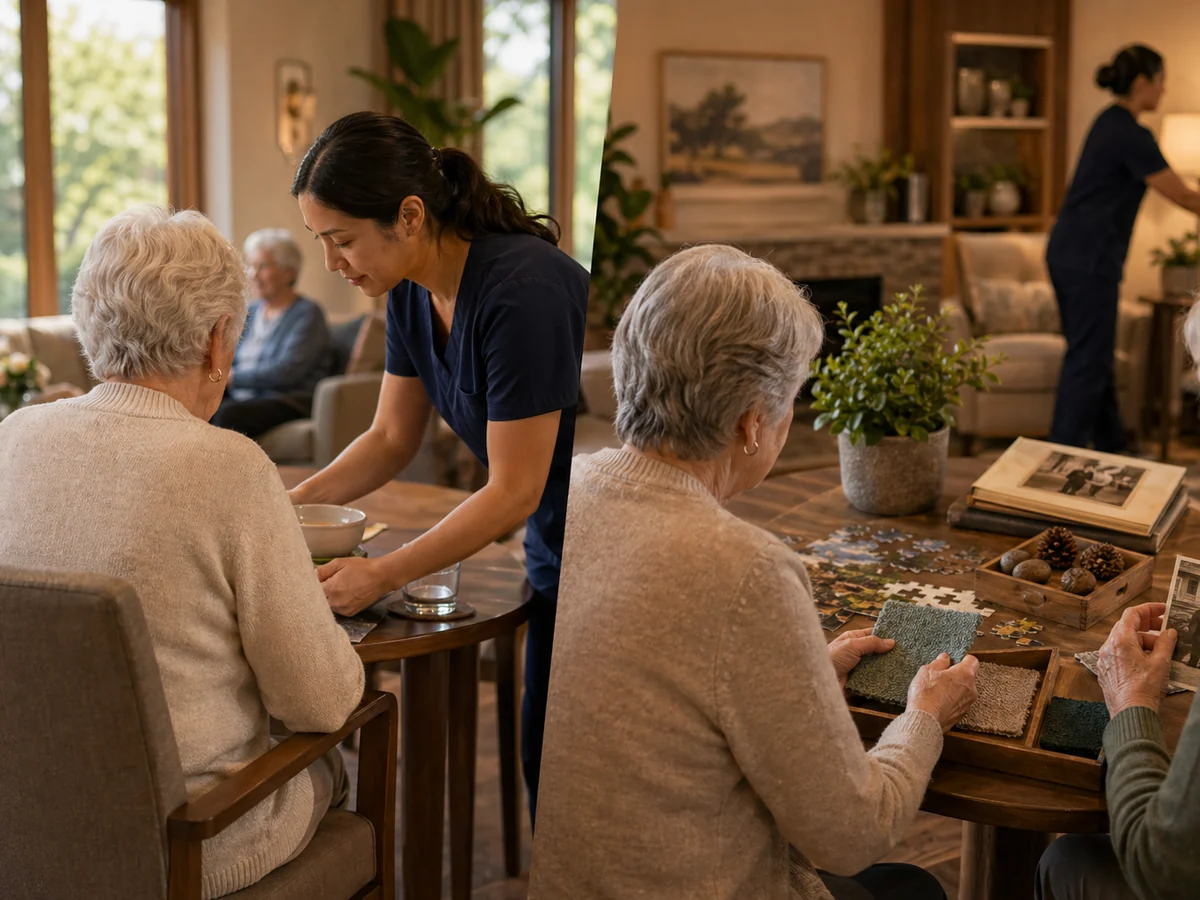
    Next step

    Schedule a tour of Velora Dos Palos.

    58 beds, assisted living plus secured memory care, opening July 2026. Administrator Elizabeth Prasad leads every family tour personally.

  • Inside a 58-Bed RCFE: How Velora Designs for Dignity

    Inside a 58-Bed RCFE: How Velora Designs for Dignity

    Senior Living

    Inside a 58-Bed RCFE: How Velora Designs for Dignity

    A behind-the-scenes look at the design decisions inside Velora’s 58-bed Dos Palos community — from wayfinding and lighting to the culinary program and secured memory care wing.

    Inside Velora's 58-bed Dos Palos community

    Why 58 beds is the sweet spot

    The first question people ask when we describe Velora Dos Palos is why it is sized the way it is. Fifty-eight beds is not an arbitrary number. In California, a Residential Care Facility for the Elderly (RCFE) between roughly 50 and 80 beds sits in a bed-count range where three things happen simultaneously: the community is large enough to employ a full-time licensed administrator, a registered nurse consultant, a culinary director, and a dedicated activities coordinator; it is small enough that every resident’s name is known by every team member on every shift; and it is financially stable enough to survive a quarter of below-projection occupancy without compromising care. Below 50 beds the staffing math gets thin. Above 80 beds you begin to build institutions — corridors that are too long, dining rooms that echo, staff who see but do not know.

    Fifty-eight is the number we and our operating team arrived at after touring communities across California, Oregon, and Arizona. It is the number at which the building still feels like a home, not a facility. We talk about this constantly with families: the deciding factor in whether a loved one thrives in senior living is almost never the square footage. It is whether the staff know the resident’s name, their daughter’s name, their grandchild’s name, what they ate for breakfast three days ago, and which activities make them smile.

    Lighting that tracks the sun

    We made one design decision early in planning that has reshaped every downstream choice: the entire common-area lighting system is tunable-white and circadian-programmed. The light temperature in the dining room, the living room, and the corridor ceiling fixtures shifts across the course of the day — cooler (around 5000K) through the morning and late morning, warmer (around 3000K) through the afternoon, and warmer still (down to 2200K) in the two hours before bedtime. This is not decorative. There is now a substantial body of research — gerontology, circadian biology, and dementia care specifically — that shows older adults with more stable light exposure patterns experience less sundowning, better sleep-wake consolidation, less agitation in the evening hours, and measurable improvements in cognitive orientation.

    Designing for circadian lighting is not expensive at construction time — the fixtures cost roughly 15% more than fixed-color equivalents — but it is nearly impossible to retrofit. Every community we have studied that installed tunable-white lighting at build has kept it. Every community that tried to retrofit has given up partway through. If you are touring a senior living community, ask whether the common-area lighting shifts across the day. The answer will tell you a great deal about how much research went into the building.

    A tunable light system costs 15% more at construction. It is the single most impactful design investment we made. Retrofitting is effectively impossible — ask every community you tour whether it was built in.

    Wayfinding for residents with cognitive decline

    The most common physical-environment failure in older senior living buildings is wayfinding. Long identical corridors, repeated door configurations, and generic room numbering that looks like a hotel — these are design patterns that work fine for a forty-year-old visitor and are actively disorienting for a resident with early-to-moderate dementia.

    Velora Dos Palos uses what gerontological designers call “progressive wayfinding cues.” The corridors are broken into short segments, never more than twelve doors before a visual break — a widened gathering alcove, a change in flooring pattern, a different wall color. Each resident’s door has a personal memory box beside it at a height of forty-four inches, which is the sitting-eye height for most residents. The memory box is a shadow-box display that families fill with photos, small objects, and reminders specific to the resident: a wedding photo, a baseball hat, a framed picture of a grandchild. Residents who cannot remember their room number can usually remember their wedding photo, and the memory box becomes the primary wayfinding cue for navigating back to their own door.

    The corridors are painted in three different color families — a sage green corridor, a warm beige corridor, and a soft coral corridor — corresponding to the three resident wings. “I live down the sage hallway” is an easier cognitive handle than “Room 214.” Flooring transitions match. Contrast between floor and wall is deliberately high (roughly 30% luminance contrast) because low-contrast floor-to-wall transitions have been linked to stumbles and falls in residents with diminishing depth perception.

    The secured memory care wing

    Sixteen of the 58 beds at Dos Palos sit inside a dedicated memory care wing. The wing is secured — meaning residents cannot exit without a staff member unlocking an egress door — but the design intent is that the residents living in the wing should not feel contained. The wing has its own secured outdoor garden (so residents can walk outside freely during daylight), its own smaller dining room (to reduce overstimulation at mealtimes), and its own activities space configured for the specific programming that works with memory care residents: music, gentle movement, tactile art, reminiscence therapy, and one-on-one social engagement rather than large-group programming.

    The secured garden is a detail that gets compromised in many memory care facilities built on tight urban sites. The garden should not be a courtyard the residents look at through glass; it should be a garden the residents can walk through, sit in, plant in, and spend hours in on a nice day. At Dos Palos, the secured garden is 4,800 square feet of enclosed outdoor space with raised planting beds at wheelchair-accessible height, a looped walking path with no dead ends (continuous-loop paths reduce agitation by eliminating the “I’m stuck” moment that a dead-end path creates), and covered seating areas shaded for Central Valley summers.

    Door hardware in the memory care wing uses concealed maglocks rather than visible keypads. The cognitive difference matters: a visible keypad is an invitation to a resident with moderate dementia to try to leave; a plain door, with a concealed lock controlled by staff proximity badges, registers as simply a door.

    Culinary as a clinical tool

    The most underrated lever in senior living quality is the food. Not because the food is social (it is), and not because eating well correlates with mood (it does), but because older adults in care settings often lose weight — unintentional weight loss is a leading contributor to decline — and the single most direct intervention is food they actually want to eat.

    Velora runs a chef-led culinary program. The kitchen is staffed by a culinary director with prior experience in restaurant kitchens, not simply institutional food-service backgrounds. The dining room seats all 58 residents in a single service at small round tables of four to six, which is the configuration that gerontological research identifies as most conducive to social eating (large tables depress food intake in older adults; isolated single-table service worsens depression markers). Menu planning runs on a four-week rotation with seasonal Central Valley produce, and dietary modifications — pureed, mechanical soft, low-sodium, diabetic — are produced to the same aesthetic standards as the standard plate. A pureed meal at Velora looks like a meal. It is not a beige scoop on a tray.

    We offer three seatings per meal — early, middle, and late — to accommodate different resident rhythms. No resident is woken up at 7 am for breakfast; a resident who sleeps until 9 is served breakfast at 9. This is a staffing decision, not a menu decision, and it reflects a broader philosophy: the community accommodates the resident’s rhythm, not the other way around.

    Family visiting spaces

    Family members who visit a senior living community once a week — or once a month — are a more influential factor in resident well-being than almost any other external input. A community that makes visiting easy, pleasant, and private extends those visits and increases their frequency. A community that forces family visits to happen on the edge of the resident’s bedroom or in a single institutional lounge shortens them.

    Dos Palos has three dedicated family visiting spaces: a living-room-style lounge with a working fireplace for long afternoon visits, a private dining room where family can reserve a meal with their loved one, and a secured outdoor garden patio for weather-permitting visits. Children are explicitly welcomed — the private dining room has a small toy chest — and the building is designed so that an adult child visiting a parent with a toddler in tow does not feel like they have imposed.

    The staff workflows in a great senior living community should be invisible to residents. The pill cart arrives because someone needs medication; the laundry gets delivered because the linens were changed. Residents experience hospitality, not operations.

    Staff workflows that stay invisible

    A common tell of an institutional-feeling senior living community is visible operations: med carts parked in corridors, laundry bins staged outside rooms, staff huddled at a nursing station during meal service. These are all operations that have to happen in any care facility. The design question is where they happen.

    Dos Palos uses back-of-house corridors — service hallways running behind the resident-facing corridors — for med-cart staging, laundry delivery, and housekeeping prep. Nursing staff have a workstation inside each resident wing, but it is a small, enclosed alcove rather than a 1970s-style central nursing station. The goal is that a resident walking to dinner, a family member visiting, or a prospective resident touring the community does not see staff “at work” — they see staff interacting with residents.

    This is not a cosmetic choice. The more the building feels like a home, the less the residents feel institutionalized, and the downstream effects on mood, agitation, and social engagement are measurable.

    Securitas Arial nurse call integration

    The clinical systems in a modern RCFE are substantially more sophisticated than they were even ten years ago. We selected the Securitas Healthcare Arial platform for nurse call, wander management, and staff communication. The system integrates a pendant call button worn by each resident, a wander-management perimeter for memory care, a real-time location system that lets staff know within seconds where a resident is if they don’t respond to a call, and a staff communication layer that consolidates what used to be three or four separate systems into a single interface.

    The practical effect: an average resident call response time under 90 seconds (the California regulatory standard is substantially looser), no reliance on radios or paper logs for shift-to-shift handoff, and a documentation audit trail that makes regulatory inspection straightforward. For families, the relevant takeaway is that if your loved one falls in their room at 2 am, a staff member is in the room faster than if they had called you on a phone.

    None of this is marketing. These are the specific design decisions that separate a well-run 58-bed RCFE from an indifferent one, and they are the questions we encourage every family to ask on every tour. Velora Dos Palos opens in July 2026; tours are available now by appointment.

    For a fuller view of the Velora firm, see our senior living hub. For investors interested in the economics of a well-designed senior living operation, our Velora Living Fund I page walks through the preferred-equity structure we use to fund FF&E and working capital into communities like this one.

  • Assisted Living vs Memory Care: Choosing the Right Level

    Assisted Living vs Memory Care: Choosing the Right Level

    Senior Living

    Assisted Living vs Memory Care: Choosing the Right Level for Your Parent
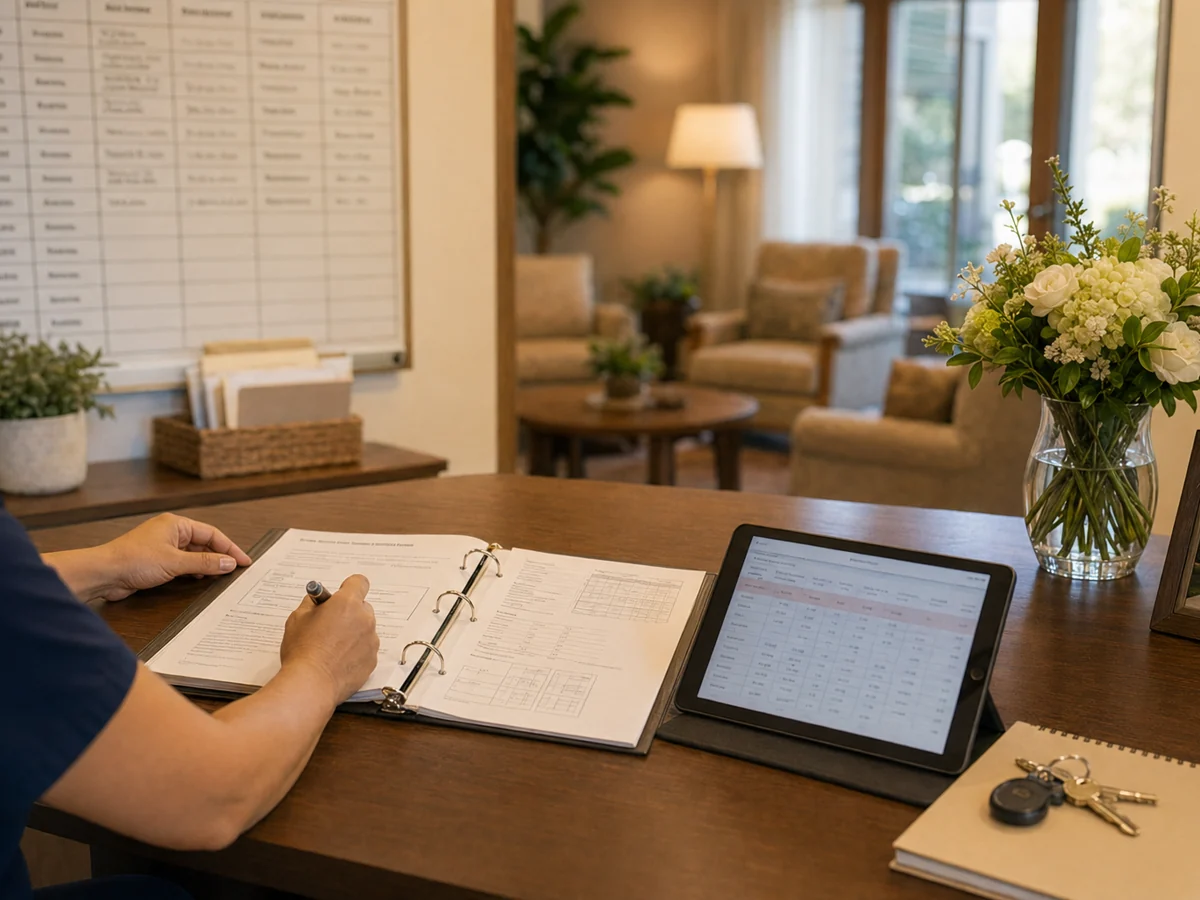
    A family guide to the real differences between assisted living and memory care — clinical staffing, physical security, programming, and how to know when it’s time to transition.

    Caregiver supporting a senior resident

    The vocabulary problem

    Most families who come to tour a senior living community are not in a stable moment. A parent has fallen, or a neighbor has called, or the phone rang at 2 a.m., or the kitchen has started smelling like gas. Something has happened that forced the question no one wants to ask — is it time? — into the open. And now the words themselves make the decision harder: assisted living, memory care, skilled nursing, residential care for the elderly, RCFE, board and care, continuing care retirement community, dementia unit, secured wing, hospice waiver. Every one of those phrases means something specific, and none of them mean the same thing.

    The goal of this piece is to make two of those words clear — assisted living and memory care — and to help you tell, honestly, which one fits your parent right now. The decision is not permanent. Most families who choose one level will eventually make a second transition, either to a higher level of care or, sometimes, back to a lower one. What matters is that today’s choice fits today’s person. That is what we try to help with at Velora Senior Living, and what this piece is meant to help you think through before you ever schedule a tour.

    What assisted living actually provides

    Assisted living, in California, is regulated under the Residential Care Facility for the Elderly (RCFE) license category. It is designed for older adults who need help with some activities of daily living — bathing, dressing, medication management, mobility, meal preparation — but who do not need the twenty-four-hour skilled nursing that a higher-acuity facility provides.

    In a well-run assisted living community, your parent lives in a private suite or apartment. They have a kitchenette or small kitchen. They decide when to get up, what to wear, whether to join breakfast in the dining room or eat in their room. Licensed caregivers and medication technicians come through on a schedule — medications at morning and evening, bathing on preferred days, assistance if someone falls or calls for help. Meals are provided in a dining room three times a day, along with an activity calendar that typically runs from gentle exercise in the morning to group activities in the afternoon and evening.

    Assisted living is, fundamentally, about preserving the texture of independent life while adding the clinical support that makes that life safe. The resident sets the pace. The staff is there when the pace slips.

    What memory care actually provides

    Memory care is a specialized form of assisted living designed for people living with Alzheimer’s disease, other dementias, or significant cognitive impairment. At the licensing level in California, memory care lives within the RCFE framework but requires additional training, staffing ratios, and physical-environment standards. Communities typically operate memory care as a secured wing — locked doors, controlled elevator access, enclosed outdoor courtyards — specifically to prevent the wandering that is a common and dangerous behavior in middle-to-late-stage dementia.

    Inside memory care, the programming is fundamentally different from assisted living. Activities are shorter and simpler, designed to match the attention span and procedural memory of residents whose cognitive abilities have shifted. Dining is more structured — plated meals, scheduled times, often smaller tables — because residents with dementia often do poorly with buffet-style choice. Lighting is calibrated to support circadian rhythm. Wayfinding uses color and imagery rather than room numbers and text. Staffing ratios are higher — in a well-run memory care wing, there are fewer residents per caregiver than in general assisted living.

    The most important clinical difference is the shift in frame. In assisted living, we ask what the resident wants to do today. In memory care, we ask what the resident is capable of doing today, and we build the day around that capability so they experience success rather than frustration.

    Assisted living preserves autonomy. Memory care preserves dignity through structure. Both matter. They are not the same thing, and trying to do one with the tools of the other is the most common source of distress we see in families who have made the wrong placement.

    The five clinical markers that suggest memory care

    The honest signal that it is time to think about memory care rather than assisted living is not any single incident. It is a pattern. If any of the following have become routine rather than exceptional, memory care deserves a serious look.

    1. Wandering. Your parent has left the house and been found somewhere they did not mean to go — at a neighbor’s, at a grocery store, at a bus stop, on a roadside. Wandering is the single most dangerous behavior in dementia and is the clinical line that most clearly distinguishes who belongs in a secured setting.
    2. Inability to recognize close family reliably. Not a missed name at a birthday party, but an extended period of confusion about who you are. This marks a stage at which the resident’s relationship with their environment has changed in a way that structure helps and choice hurts.
    3. Meal refusal or safety issues around food. Forgetting to eat, forgetting they have eaten, eating non-food items, forgetting how to use utensils, significant weight loss. Memory care dining is built around these issues.
    4. Medication non-compliance beyond reminders. In assisted living, a medication technician reminds and observes. If your parent is refusing medications, hiding them, or unable to understand why they are being asked to take them, the support model needs to be different.
    5. Increasing agitation, sundowning, or nighttime confusion. Late-afternoon and evening agitation is a very common dementia pattern. Assisted living staffing thins in the evening; memory care staffing does not. A parent who becomes more confused or more distressed at night often settles better in a community built to support that pattern.

    None of these markers is a life sentence. Many residents transition from memory care back to lighter programming if their underlying condition stabilizes. But if your parent is showing two or more of these patterns consistently, the right first question is whether memory care would actually be more comfortable — for them — than assisted living.

    Physical design differences that matter

    Walk into an assisted living community and a memory care wing and the design tells you the level of care before anyone speaks. In assisted living, hallways are long, residents come and go freely, dining is often buffet-style, and common areas invite drop-in use. Lobbies have reception, mail rooms, and the general feel of a small hotel.

    In memory care, hallways are shorter and less confusing, usually arranged around a central common area so that residents can always see where they are. Doors to the outside are secured, with release mechanisms and monitoring. Courtyards are enclosed by design — residents can go outside whenever they want, but only into spaces that are safe. Color, signage, and wayfinding are oriented to procedural memory rather than reading. Bathrooms are designed with contrast (dark toilet seats on light floors, for example) so that objects are visible to someone whose spatial processing has changed. Lighting is brighter during the day to support wake cycles, dimmer in the evening.

    These details are not decoration. They are the clinical intervention. Memory care without the physical-environment design is just assisted living with a locked door, and it does not produce the same outcomes.

    Costs compared

    In the Bay Area and Central Valley in 2026, assisted living generally runs in the $5,500 to $8,500 per month range for a private suite, depending on community quality, suite size, and the level of care add-ons. Memory care runs higher — typically $7,000 to $11,000 per month for the same footprint — because of the additional staffing, training, and physical infrastructure. Both fees usually include rent, all meals, housekeeping, and base-level care; higher-acuity care tiers are billed separately as residents’ needs evolve.

    Long-term care insurance policies, veterans’ Aid & Attendance, and in rare cases Medi-Cal Assisted Living Waivers can offset some of this cost. Medicare, contrary to a widespread assumption, generally does not cover assisted living or memory care long-term; it covers post-acute skilled nursing on a short-term basis and is not the right payer for a residential long-term-care decision. A conversation with a fee-only elder-law attorney or a certified financial planner with senior-care expertise is worth having early rather than late.

    Transitioning between levels

    The best communities are designed so that residents can move between levels without moving between buildings. A resident who starts in assisted living and eventually needs memory care should not have to leave the staff, dining room, and activities program they have come to know. At Velora Dos Palos, our secured memory care wing is integrated into the broader community — the same chef, the same clinical leadership, the same family visiting spaces. A resident who transitions from assisted living into memory care after a year in the community keeps their caregivers, their neighbors, and the texture of the place that has become home.

    Transitions are emotionally loaded. The decision to move a parent from a familiar apartment to a secured wing feels, to the adult child, like a step they are taking away from their parent. It is usually the opposite — it is a step toward the level of support the parent actually needs. When the move happens in a community the family and resident already know, the transition is less traumatic than a move between buildings.

    The right time to look at a community with both levels is before you need either one. Families who visit early, while a parent is still living independently at home, make different decisions than families who visit after a crisis.

    Questions to ask on every tour

    When you tour an assisted living community or a memory care wing, the marketing materials will tell you what the community wants to be known for. These questions, asked of the administrator and the clinical director, tell you what it actually is.

    1. What is your staffing ratio at night? Residents do not stop needing help at 10 p.m. The ratio you see on the day shift is not the ratio at 3 a.m.
    2. What happens when a resident’s needs increase? Does the community accommodate the change, or is the family asked to find somewhere else? Ask specifically about hospice waiver — communities that hold a hospice waiver can care for residents through end-of-life without a forced move.
    3. How are medications managed? Ask to see the medication room, the documentation, and the process for MAR (medication administration record) review.
    4. What is your fall protocol? Falls are the number-one clinical event in senior living. A community that has a clear, practiced response is a safer community.
    5. Can I see your latest state inspection report? California RCFE inspection reports are public. A community that cannot produce it, or is not comfortable doing so, is telling you something.

    Pay attention to what the building smells like. Pay attention to whether residents are alone in their rooms or engaged in the common areas. Pay attention to whether staff know residents’ names without looking at name tags. The details that matter are the ones you have to notice rather than be told.

    The choice between assisted living and memory care is not one most families want to make. None of us planned on making it. The good news, if there is good news in this conversation, is that it is a choice you can make well. The right community — at the right level — changes the story. The parent who was combative at home because their confusion was frightening becomes a resident who laughs at lunch because the structure has taken the fear away. That shift is what these places, at their best, do.

    If you would like to walk through a community that holds both levels of care under one roof — and talk with our administrator about your parent’s specific situation — we are glad to schedule a tour or a call. Velora Senior Living has the full community details, and a direct message is the simplest way to start.

    Related

    Next step

    Schedule a tour.

    Velora Dos Palos holds both assisted living and secured memory care. We’d be glad to walk you through the community and talk about your parent’s situation.