
EB-5 vs E-2 Visa: Which Is Right for Your Family in 2026?
A side-by-side comparison of EB-5 and E-2 visas for foreign investors weighing US immigration in 2026 — requirements, timelines, green card pathways, and capital commitment.
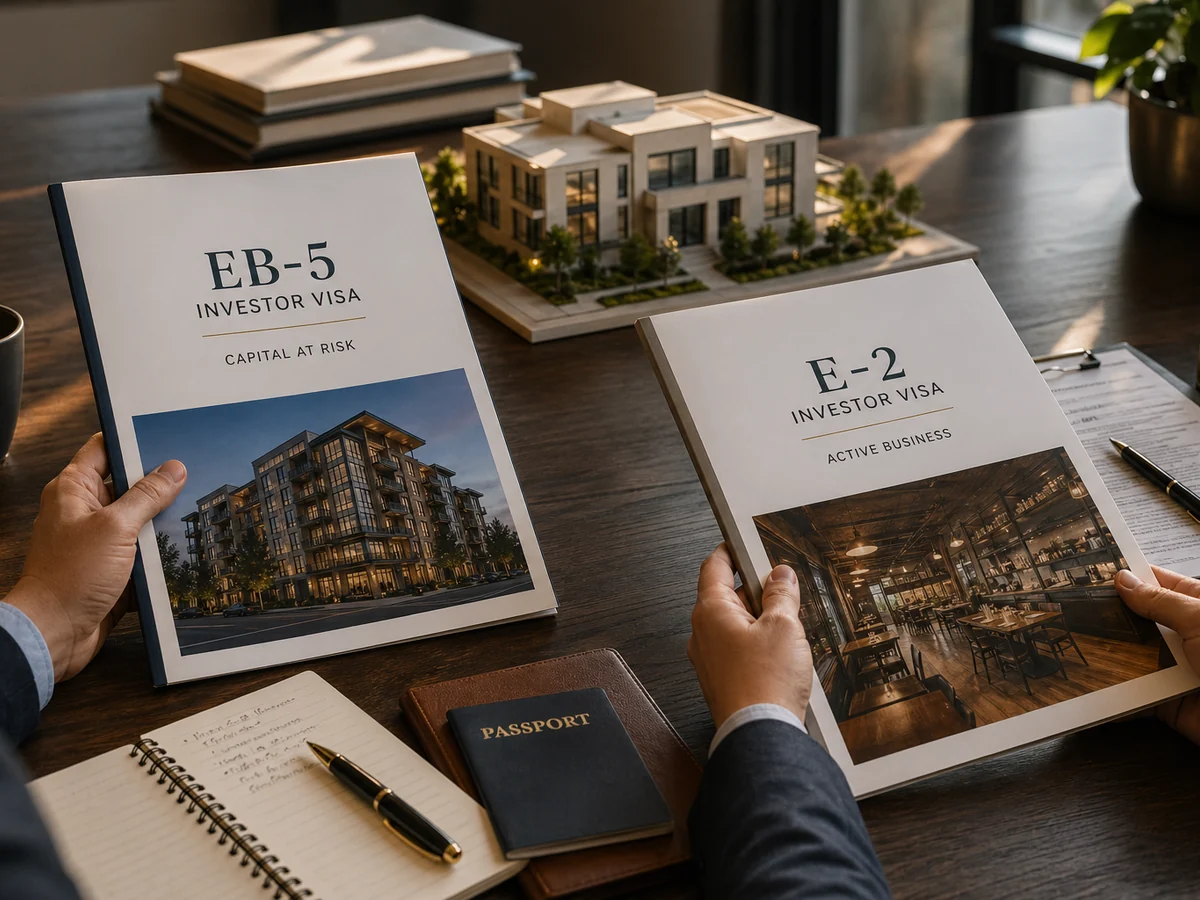
The two most common investor visas
Most foreign investors asking about US immigration through capital — not employment, not family, not lottery — end up at the same two doors. One is the EB-5, a permanent-residency program that requires an at-risk investment of $800,000 or $1,050,000 depending on geography. The other is the E-2, a non-immigrant treaty visa that allows an investor and their immediate family to live and work in the United States for as long as the qualifying business stays alive. Both are legitimate. Neither is a shortcut. And the difference between them is not a small one — it shapes where your children go to college, whether your spouse can accept a job at Apple, and what happens to your status if the business you funded goes sideways.
We work with investors from roughly a dozen sending countries, and the single most common mistake we see is treating these two visas as interchangeable. They are not. EB-5 is an immigration program; E-2 is a business-presence program. The first gets you a green card. The second gets you a renewable visa. That one-sentence distinction is worth reading twice.
EB-5 at a glance
EB-5, created by Congress in 1990 and overhauled by the EB-5 Reform and Integrity Act of 2022, is a path to a US green card for foreign nationals who invest in a new commercial enterprise that creates at least ten full-time American jobs. The 2022 reforms set two investment tiers: $800,000 for projects located in a Targeted Employment Area (TEA) — rural zones or high-unemployment census tracts — and $1,050,000 for projects outside a TEA. The program is open to nationals of any country, with per-country cap rules that create backlogs for high-volume senders (India and China in particular).
The approval sequence runs from an I-526E petition (investor-specific), through conditional permanent residency for the investor, spouse, and unmarried children under 21, to an I-829 petition at year five to remove conditions. In a clean case with a well-documented source of funds and a project that actually creates the jobs it promises, the full timeline from commitment to unconditional green card is roughly five to eight years.
EB-5 is the only US investor program that delivers a green card. Every other investor-category visa — E-2, L-1A, EB-1C, O-1, even the proposed "gold card" frameworks that surface in policy discussions — asks you to either convert, renew, or never become permanent.
E-2 at a glance
The E-2 is a non-immigrant treaty investor visa. It is available only to nationals of countries that hold a qualifying commerce-and-navigation treaty with the United States. The substantial-investment threshold is not codified in dollar terms — there is no $800,000 number — but consular officers typically expect something in the range of $100,000 to $250,000 for a small service business, and more for capital-intensive operations. The investment must be "substantial in relation to the total cost" of the enterprise, the business must be real and operating (not marginal, not speculative), and the investor must direct and develop it.
The E-2 visa is issued for up to five years at a time (the stamp length depends on reciprocity with the investor's country) and is renewable indefinitely so long as the business continues to qualify. The investor's spouse is eligible for open-market work authorization — meaning a spouse can accept a job with any US employer, a meaningful benefit that frequently tips the decision when both partners have careers. Children under 21 can attend school but cannot work, and they age out of E-2 dependent status on their 21st birthday, which is the single biggest limitation of the visa for families with teenagers.
The green card question — the biggest divider
If you want a US green card, you want EB-5. If you want a legal basis to live and run a business in the United States without committing to permanent immigration, you want E-2. Everything else — the capital difference, the timeline difference, the job-creation requirement — flows from this one distinction.
An E-2 holder can live in the United States for decades, build a business, raise children, pay US taxes, and never be a permanent resident. Status is tied to the qualifying business. If the business closes, the visa ends. There is no automatic path from E-2 to green card; conversion typically happens through a separate employment-based petition (EB-1, EB-2, EB-5) or a family-based filing. An EB-5 holder, once they clear the I-829, is a lawful permanent resident with full work authorization, the right to live anywhere in the US, and — after five years as a permanent resident — eligibility to apply for citizenship.
Capital commitment comparison
EB-5 requires $800,000 minimum in a TEA project or $1,050,000 outside one. The capital must be "at risk," meaning no guaranteed return of principal. Funds are deposited into a regional center or direct project escrow and released to the new commercial enterprise once the I-526E is filed or approved, depending on the sponsor's structure.
E-2 has no statutory floor. A small restaurant with $150,000 of real invested capital, leases signed, equipment purchased, and employees hired can qualify. A $2 million tech company can also qualify. What the consular officer looks for is proportionality — that the investor has irrevocably committed enough capital to make the business real rather than theoretical. The phrase to internalize is "at risk and irrevocably committed." Funds sitting in an escrow account are not committed. Funds spent on lease, inventory, licensing, and payroll are committed.
Time to residency
This is where expectations often break. EB-5 processing times in 2026 remain uneven. For investors from countries without a backlog, the I-526E adjudication window is running in the 18 to 30 month range. For Indian and Chinese nationals, per-country visa caps add additional wait after petition approval before a visa number is available. A realistic range is three to five years from commitment to conditional green card, plus another three years to unconditional status. Families should plan around this timeline rather than around what a marketing brochure implies.
E-2 is materially faster. Consular processing in most posts runs six to twelve weeks from application to visa stamp. For an investor who has already chosen a business, negotiated a lease, and wired capital, moving from "decision made" to "living in the US" is typically three to six months. That speed advantage is the second-biggest argument for E-2, behind the spouse work authorization.
Speed favors E-2. Permanence favors EB-5. If you need to be in the US within a year for a spouse's job or a child's school admission, EB-5 will not get you there. If you need permanent status before a child turns 21, E-2 is a dead end.
Family considerations
Both visas extend to spouses and unmarried children under 21. The practical differences are sharper than the rulebook suggests.
EB-5. Once conditional green cards are issued, every family member has full US work authorization and can attend US public schools and in-state universities (where state residency is achieved). Children who are under 21 at the time the I-526E is filed are "locked in" for the family's petition under the Child Status Protection Act, which preserves their eligibility even if the adjudication stretches past their 21st birthday.
E-2. The spouse gets open work authorization — a powerful benefit for dual-career households. Children can study but cannot work, and they age out of dependent status at 21, at which point they need their own visa status (typically an F-1 student visa, an H-1B if they have an employer, or a separate petition). For a family with a 15-year-old, E-2 gives roughly six dependent-status years; for a family with a 19-year-old, under two.
Country-specific notes
The country you are applying from changes the math in ways that are easy to miss if you read only the general rulebook.
India
India is not an E-2 treaty country. Indian nationals cannot apply for an E-2 visa directly — the nearest analog is L-1A (intracompany transfer) or EB-5. For the large population of Indian investors with liquidity from business exits, real estate, or inherited capital, EB-5 is effectively the only capital-based US immigration path. The India category does carry a visa-number backlog post-I-526E approval, but the RIA 2022 reforms created set-aside visas for rural, high-unemployment, and infrastructure projects that have significantly shortened the effective wait for Indian nationals investing in those categories. Source-of-funds documentation for Indian investors is its own discipline — gift affidavits, property sale records, and tax returns denominated in rupees all require careful preparation.
China
China is also not an E-2 treaty country. Chinese nationals historically faced the longest EB-5 backlog of any sending country, but the RIA 2022 set-asides have again eased the math for investors willing to invest in rural or high-unemployment TEA projects. Foreign-exchange control regulations ($50,000 per person per year) make the practical mechanics of moving $800,000 to a US escrow more complex for Chinese investors than for almost any other nationality; this is solved by structuring the transfer through multiple family members over several years, and is a problem your immigration attorney and a qualified Chinese tax advisor should solve together.
Taiwan
Taiwan is an E-2 treaty country. Taiwanese investors have both options available. The typical pattern we see is an E-2 first (fast, modest capital, spouse work authorization) followed by a later EB-5 if the family decides to stay permanently.
United Kingdom
The UK is an E-2 treaty country. UK nationals have the full menu. Given the strong dollar, the rise in UK domicile-tax reforms, and the number of UK-based tech founders already running businesses in the US through L-1, E-2 is very common. EB-5 is used by UK families where a child is applying to US universities and permanent status would materially change the financial aid or in-state tuition picture.
Mexico
Mexico is an E-2 treaty country. The E-2 is heavily used by Mexican business owners who already operate across both sides of the border. EB-5 activity from Mexico has been rising, driven by private-school and university placement for children and by the relative stability premium that a US green card offers in an environment where domestic policy can shift quickly.
South Korea
South Korea is an E-2 treaty country. Korean investors use E-2 extensively for small to mid-size business immigration and have been growing users of EB-5, especially among families with college-age children applying to US institutions. The cultural pattern here is often a multi-generational decision — parents invest to establish status for adult children already studying in the US.
Which is right for you?
Start with the outcome you are trying to buy.
If the outcome is a US green card — with the right for every family member to work anywhere, permanent residency regardless of what happens to the business, and eligibility for citizenship in due course — EB-5 is the answer. It costs more. It takes longer. It also delivers something E-2 does not and cannot.
If the outcome is a legal basis to live in the United States and run a real business, with your spouse free to take any US job, your kids in US schools, and no commitment to permanent residency — E-2 is the answer. It costs less. It is faster. And for many families who are not certain they want to immigrate permanently, that optionality is itself the product.
The third answer, which we see often, is "E-2 now, EB-5 later." Families use the E-2 to move, live, and decide. After three or five years on the ground, they know whether they want permanence. If they do, they start an EB-5 petition with the patience that knowing buys.
None of this is legal advice. Fremont Developers is not a law firm and does not provide immigration advice. We do fund and operate EB-5-eligible projects, and we work alongside the immigration attorneys our investors choose. The right first step for any family weighing these two visas is a conversation with qualified immigration counsel who can look at the specific facts — passport, assets, family timeline — and tell you which door is the one you should actually walk through.
If you'd like to talk through whether one of our current EB-5 projects fits your family's plan, we're glad to set that up. The details live on our EB-5 page, and the fastest way to start is a direct message.
Related

How to Verify Accredited Investor Status: A Rule 506(c) Walkthrough
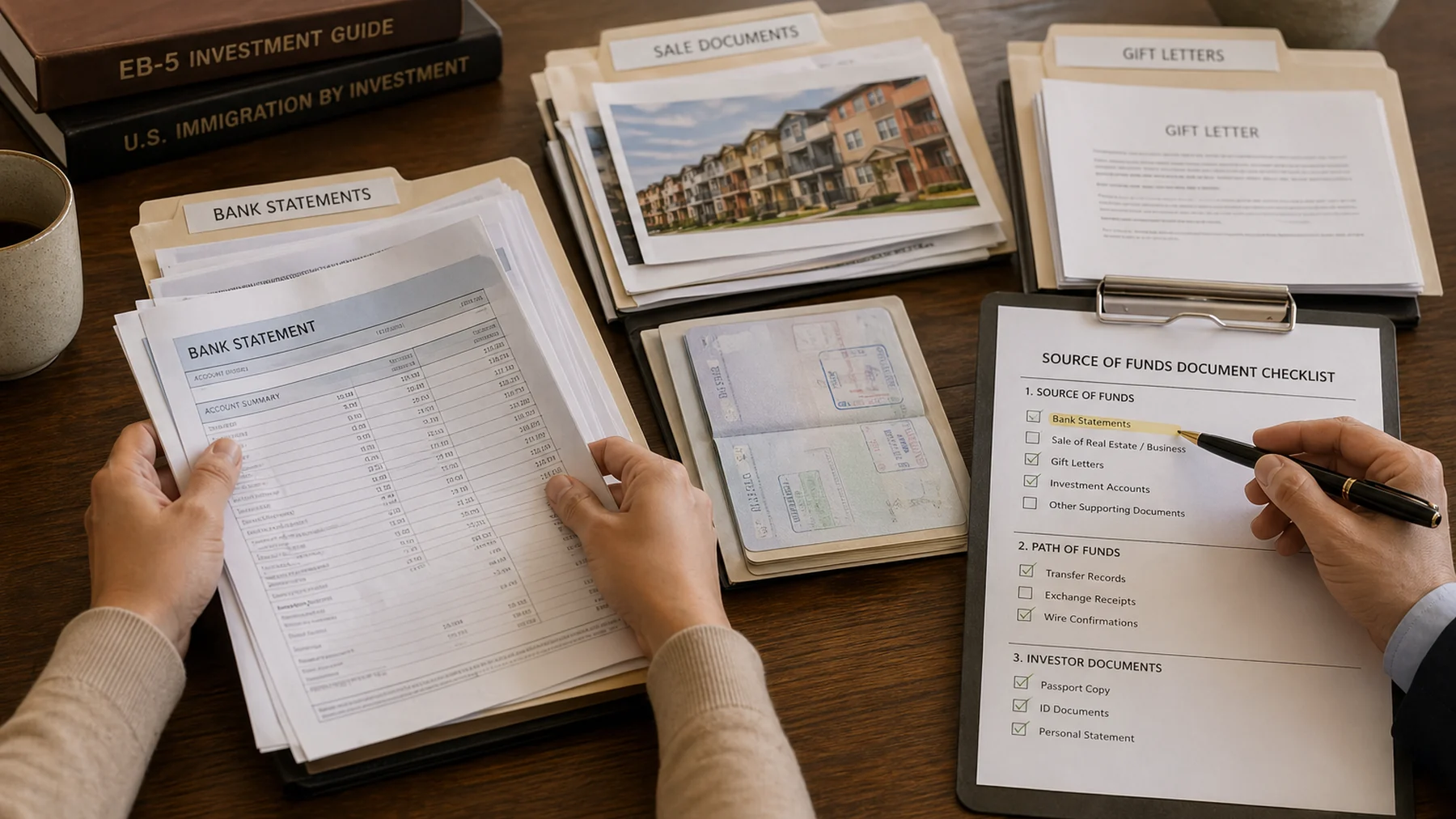
EB-5 Source of Funds: A Practical Guide for Indian and Chinese Investors

Qualified Opportunity Zones Explained: A Bay Area Investor's Guide to 2026
Thinking about an EB-5 petition?
We fund and operate EB-5-eligible projects in the Bay Area and Central Valley. If you'd like to understand our current tranches, source-of-funds process, and project timelines, we're glad to talk.