
Assisted Living vs Memory Care: Choosing the Right Level for Your Parent
A family guide to the real differences between assisted living and memory care — clinical staffing, physical security, programming, and how to know when it's time to transition.
The vocabulary problem
Most families who come to tour a senior living community are not in a stable moment. A parent has fallen, or a neighbor has called, or the phone rang at 2 a.m., or the kitchen has started smelling like gas. Something has happened that forced the question no one wants to ask — is it time? — into the open. And now the words themselves make the decision harder: assisted living, memory care, skilled nursing, residential care for the elderly, RCFE, board and care, continuing care retirement community, dementia unit, secured wing, hospice waiver. Every one of those phrases means something specific, and none of them mean the same thing.
The goal of this piece is to make two of those words clear — assisted living and memory care — and to help you tell, honestly, which one fits your parent right now. The decision is not permanent. Most families who choose one level will eventually make a second transition, either to a higher level of care or, sometimes, back to a lower one. What matters is that today's choice fits today's person. That is what we try to help with at Velora Senior Living, and what this piece is meant to help you think through before you ever schedule a tour.
What assisted living actually provides
Assisted living, in California, is regulated under the Residential Care Facility for the Elderly (RCFE) license category. It is designed for older adults who need help with some activities of daily living — bathing, dressing, medication management, mobility, meal preparation — but who do not need the twenty-four-hour skilled nursing that a higher-acuity facility provides.
In a well-run assisted living community, your parent lives in a private suite or apartment. They have a kitchenette or small kitchen. They decide when to get up, what to wear, whether to join breakfast in the dining room or eat in their room. Licensed caregivers and medication technicians come through on a schedule — medications at morning and evening, bathing on preferred days, assistance if someone falls or calls for help. Meals are provided in a dining room three times a day, along with an activity calendar that typically runs from gentle exercise in the morning to group activities in the afternoon and evening.
Assisted living is, fundamentally, about preserving the texture of independent life while adding the clinical support that makes that life safe. The resident sets the pace. The staff is there when the pace slips.
What memory care actually provides
Memory care is a specialized form of assisted living designed for people living with Alzheimer's disease, other dementias, or significant cognitive impairment. At the licensing level in California, memory care lives within the RCFE framework but requires additional training, staffing ratios, and physical-environment standards. Communities typically operate memory care as a secured wing — locked doors, controlled elevator access, enclosed outdoor courtyards — specifically to prevent the wandering that is a common and dangerous behavior in middle-to-late-stage dementia.
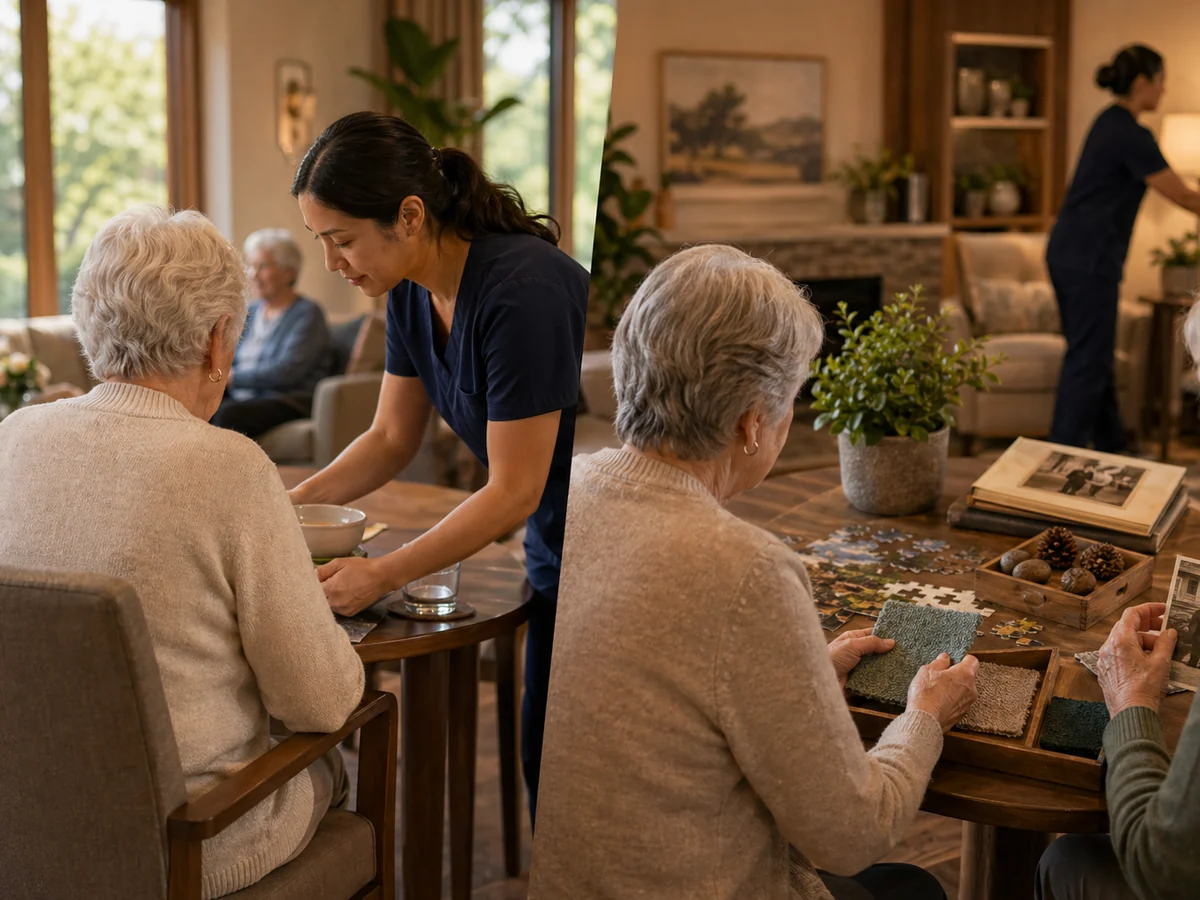
Inside memory care, the programming is fundamentally different from assisted living. Activities are shorter and simpler, designed to match the attention span and procedural memory of residents whose cognitive abilities have shifted. Dining is more structured — plated meals, scheduled times, often smaller tables — because residents with dementia often do poorly with buffet-style choice. Lighting is calibrated to support circadian rhythm. Wayfinding uses color and imagery rather than room numbers and text. Staffing ratios are higher — in a well-run memory care wing, there are fewer residents per caregiver than in general assisted living.
The most important clinical difference is the shift in frame. In assisted living, we ask what the resident wants to do today. In memory care, we ask what the resident is capable of doing today, and we build the day around that capability so they experience success rather than frustration.
Assisted living preserves autonomy. Memory care preserves dignity through structure. Both matter. They are not the same thing, and trying to do one with the tools of the other is the most common source of distress we see in families who have made the wrong placement.
The five clinical markers that suggest memory care
The honest signal that it is time to think about memory care rather than assisted living is not any single incident. It is a pattern. If any of the following have become routine rather than exceptional, memory care deserves a serious look.
- Wandering. Your parent has left the house and been found somewhere they did not mean to go — at a neighbor's, at a grocery store, at a bus stop, on a roadside. Wandering is the single most dangerous behavior in dementia and is the clinical line that most clearly distinguishes who belongs in a secured setting.
- Inability to recognize close family reliably. Not a missed name at a birthday party, but an extended period of confusion about who you are. This marks a stage at which the resident's relationship with their environment has changed in a way that structure helps and choice hurts.
- Meal refusal or safety issues around food. Forgetting to eat, forgetting they have eaten, eating non-food items, forgetting how to use utensils, significant weight loss. Memory care dining is built around these issues.
- Medication non-compliance beyond reminders. In assisted living, a medication technician reminds and observes. If your parent is refusing medications, hiding them, or unable to understand why they are being asked to take them, the support model needs to be different.
- Increasing agitation, sundowning, or nighttime confusion. Late-afternoon and evening agitation is a very common dementia pattern. Assisted living staffing thins in the evening; memory care staffing does not. A parent who becomes more confused or more distressed at night often settles better in a community built to support that pattern.
None of these markers is a life sentence. Many residents transition from memory care back to lighter programming if their underlying condition stabilizes. But if your parent is showing two or more of these patterns consistently, the right first question is whether memory care would actually be more comfortable — for them — than assisted living.
Physical design differences that matter
Walk into an assisted living community and a memory care wing and the design tells you the level of care before anyone speaks. In assisted living, hallways are long, residents come and go freely, dining is often buffet-style, and common areas invite drop-in use. Lobbies have reception, mail rooms, and the general feel of a small hotel.
In memory care, hallways are shorter and less confusing, usually arranged around a central common area so that residents can always see where they are. Doors to the outside are secured, with release mechanisms and monitoring. Courtyards are enclosed by design — residents can go outside whenever they want, but only into spaces that are safe. Color, signage, and wayfinding are oriented to procedural memory rather than reading. Bathrooms are designed with contrast (dark toilet seats on light floors, for example) so that objects are visible to someone whose spatial processing has changed. Lighting is brighter during the day to support wake cycles, dimmer in the evening.
These details are not decoration. They are the clinical intervention. Memory care without the physical-environment design is just assisted living with a locked door, and it does not produce the same outcomes.
Costs compared
In the Bay Area and Central Valley in 2026, assisted living generally runs in the $5,500 to $8,500 per month range for a private suite, depending on community quality, suite size, and the level of care add-ons. Memory care runs higher — typically $7,000 to $11,000 per month for the same footprint — because of the additional staffing, training, and physical infrastructure. Both fees usually include rent, all meals, housekeeping, and base-level care; higher-acuity care tiers are billed separately as residents' needs evolve.
Long-term care insurance policies, veterans' Aid & Attendance, and in rare cases Medi-Cal Assisted Living Waivers can offset some of this cost. Medicare, contrary to a widespread assumption, generally does not cover assisted living or memory care long-term; it covers post-acute skilled nursing on a short-term basis and is not the right payer for a residential long-term-care decision. A conversation with a fee-only elder-law attorney or a certified financial planner with senior-care expertise is worth having early rather than late.
Transitioning between levels
The best communities are designed so that residents can move between levels without moving between buildings. A resident who starts in assisted living and eventually needs memory care should not have to leave the staff, dining room, and activities program they have come to know. At Velora Dos Palos, our secured memory care wing is integrated into the broader community — the same chef, the same clinical leadership, the same family visiting spaces. A resident who transitions from assisted living into memory care after a year in the community keeps their caregivers, their neighbors, and the texture of the place that has become home.
Transitions are emotionally loaded. The decision to move a parent from a familiar apartment to a secured wing feels, to the adult child, like a step they are taking away from their parent. It is usually the opposite — it is a step toward the level of support the parent actually needs. When the move happens in a community the family and resident already know, the transition is less traumatic than a move between buildings.
The right time to look at a community with both levels is before you need either one. Families who visit early, while a parent is still living independently at home, make different decisions than families who visit after a crisis.
Questions to ask on every tour
When you tour an assisted living community or a memory care wing, the marketing materials will tell you what the community wants to be known for. These questions, asked of the administrator and the clinical director, tell you what it actually is.
- What is your staffing ratio at night? Residents do not stop needing help at 10 p.m. The ratio you see on the day shift is not the ratio at 3 a.m.
- What happens when a resident's needs increase? Does the community accommodate the change, or is the family asked to find somewhere else? Ask specifically about hospice waiver — communities that hold a hospice waiver can care for residents through end-of-life without a forced move.
- How are medications managed? Ask to see the medication room, the documentation, and the process for MAR (medication administration record) review.
- What is your fall protocol? Falls are the number-one clinical event in senior living. A community that has a clear, practiced response is a safer community.
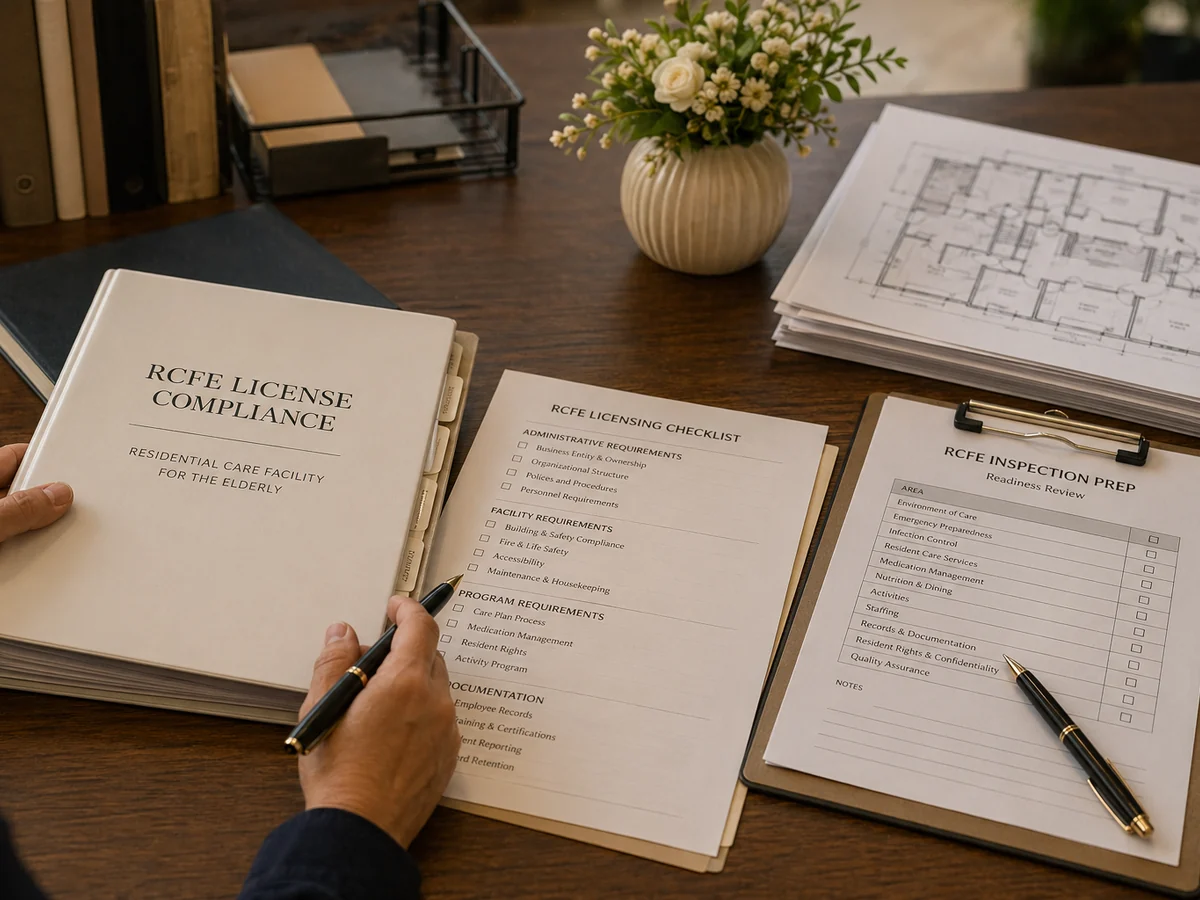
- Can I see your latest state inspection report? California RCFE inspection reports are public. A community that cannot produce it, or is not comfortable doing so, is telling you something.
Pay attention to what the building smells like. Pay attention to whether residents are alone in their rooms or engaged in the common areas. Pay attention to whether staff know residents' names without looking at name tags. The details that matter are the ones you have to notice rather than be told.
The choice between assisted living and memory care is not one most families want to make. None of us planned on making it. The good news, if there is good news in this conversation, is that it is a choice you can make well. The right community — at the right level — changes the story. The parent who was combative at home because their confusion was frightening becomes a resident who laughs at lunch because the structure has taken the fear away. That shift is what these places, at their best, do.
If you would like to walk through a community that holds both levels of care under one roof — and talk with our administrator about your parent's specific situation — we are glad to schedule a tour or a call. Velora Senior Living has the full community details, and a direct message is the simplest way to start.
Related

Inside a 58-Bed RCFE: How Velora Designs for Dignity
Understanding California RCFE Licensing: What Families Should Ask

Preferred Equity vs Common Equity in Senior Living Syndications
Schedule a tour.
Velora Dos Palos holds both assisted living and secured memory care. We'd be glad to walk you through the community and talk about your parent's situation.