

A green card. And a building.
The EB-5 Immigrant Investor Program grants conditional lawful permanent residence to foreign nationals who invest in US job-creating enterprises. Fremont Developers sponsors EB-5 investments in TEA-qualified California projects, prepared with qualified immigration counsel.
EB-5, briefly.
Congress created the EB-5 Immigrant Investor Program in 1990 to stimulate the US economy through job creation and capital investment by foreign investors. In exchange for a qualifying investment into a new commercial enterprise that creates at least ten full-time US jobs, the investor and their immediate family become eligible for lawful permanent residency — commonly known as a green card.
The program was meaningfully reformed by the EB-5 Reform and Integrity Act of 2022 (RIA), which introduced audit requirements, stricter Regional Center oversight, set-aside visa categories for rural and high-unemployment Targeted Employment Areas, and mandatory third-party fund administration. RIA also reauthorized the Regional Center Program through September 2027.
Two investment thresholds apply: $1,050,000 for standard investments and $800,000 for investments in a Targeted Employment Area (TEA) — either a rural area or an area experiencing unemployment at 150% of the national average. Nearly all Fremont Developers EB-5 offerings qualify for the TEA minimum because our Central Valley senior living projects sit in rural-designated counties, and our Bay Area projects can qualify under high-unemployment census-tract logic.
After approval of the I-526E petition, investors and their immediate family (spouse and unmarried children under 21) receive a two-year conditional green card. Before the two-year anniversary, the investor files an I-829 petition to remove conditions — at which point, subject to sustained job creation and investment, the conditions lift and the green card becomes unconditional.
Direct investment or Regional Center.
Same capital commitment, same residency outcome, different structure and job-counting methodology. We offer both.
Direct investment
Investor capital goes directly into the new commercial enterprise that creates the jobs.
Pros
- Greater operational transparency and control
- No Regional Center fee layer
- Direct economic interest in a specific project
Cons
- Only direct W-2 jobs count (no indirect/induced)
- Higher scrutiny on job creation evidence
- Tighter geographic concentration
Regional Center
USCIS-designated Regional Center pools investor capital into a Job-Creating Entity and counts indirect and induced jobs via an approved economic methodology.
Pros
- Indirect and induced jobs count via RIMS II or IMPLAN modeling
- Larger projects with diversified risk
- Easier I-829 condition removal in most cases
- TEA set-aside visa priority (per RIA)
Cons
- Regional Center administrative fee
- Less day-to-day operational visibility
Eight milestones from inquiry to unconditional green card.
-
i.
Week 0 — Engage
Initial call with Fremont Developers and your immigration attorney. Confirm eligibility, preferred project, and timing. Sign engagement letters.
-
ii.
Week 4 — Accreditation and source of funds
Gather documentation for lawful source of funds (bank statements, tax returns, property sale records, gift affidavits). Your immigration attorney drafts the source-of-funds narrative.
-
iii.
Week 8 — Subscribe
Execute Subscription Agreement and Operating Agreement. Wire $800,000 into the project escrow (plus administrative and legal fees).
-
iv.
Month 3 — I-526E filed
Immigration attorney files Form I-526E (Immigrant Petition by Regional Center Investor) with USCIS. Filing receipt confirms the petition is in queue.
-
v.
Month 18 — I-526E approved
Typical adjudication range under RIA runs 12–36 months depending on country of chargeability and set-aside category. TEA rural set-asides currently move faster.
-
vi.
Month 24 — Conditional green card
Consular processing or adjustment of status grants a two-year conditional green card for investor, spouse, and unmarried children under 21.
-
vii.
Year 5 — I-829 filed
Within 90 days before the two-year anniversary of conditional residency, file Form I-829 (Petition by Entrepreneur to Remove Conditions) with evidence of sustained investment and job creation.
-
viii.
Year 5–8 — Unconditional green card
I-829 approval removes the conditions. Five years of lawful permanent residency (counting from conditional approval) makes the investor eligible to apply for US citizenship through naturalization.
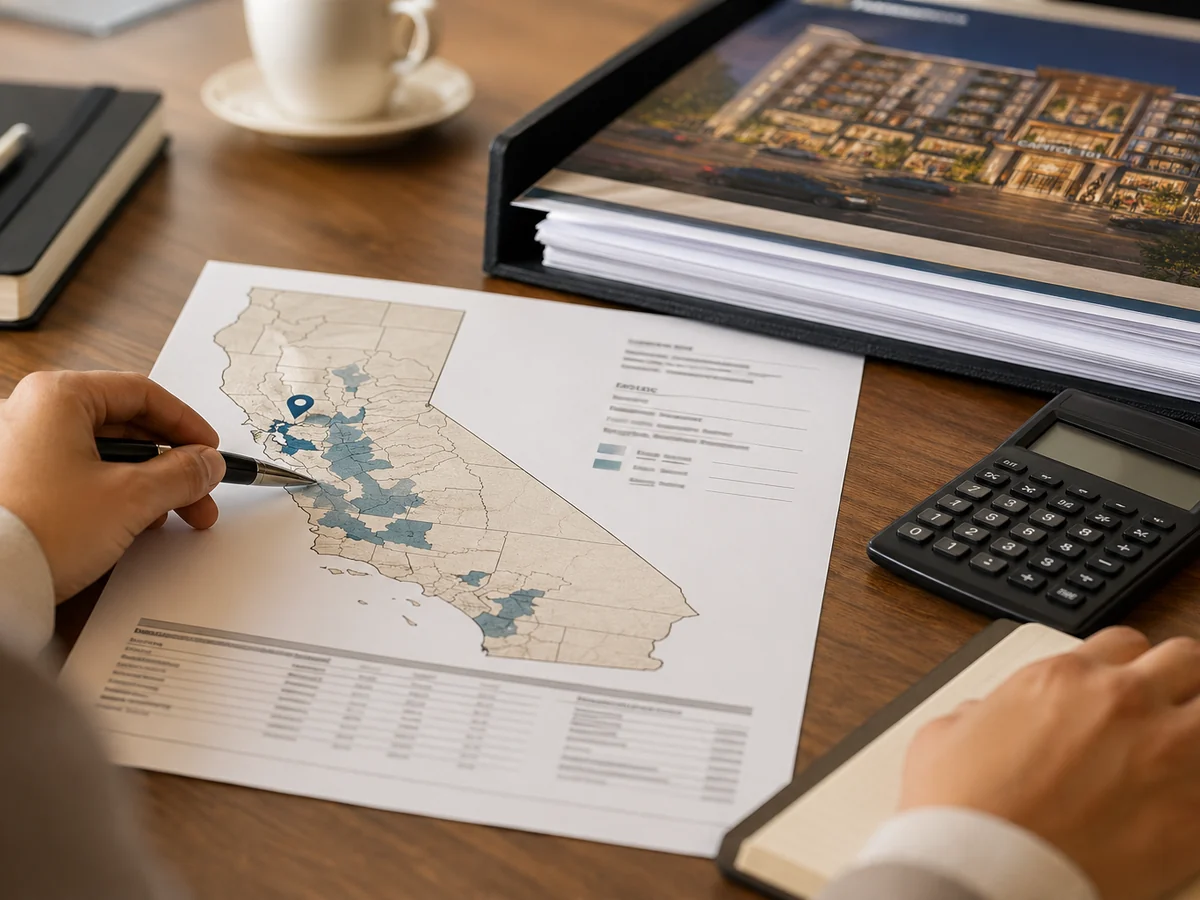
Why our projects qualify for $800K.
A Targeted Employment Area is either a rural area (as defined by USCIS) or an area experiencing unemployment at 150% or more of the national average. TEA status unlocks the lower $800,000 investment threshold — versus $1,050,000 for standard investments.
Our qualifying geography
- Velora Dos Palos (Merced County) — rural TEA. 58-bed senior living community opening July 2026.
- Golden Years Chowchilla (Madera County) — rural TEA. 41-bed assisted living facility operating.
- Capitol 101 (Fremont) — evaluated for high-unemployment census-tract TEA status at time of filing.
TEA designation is determined at the time of investment and documented by your immigration attorney using the most recent federal unemployment data.
A family currently in process.
Deepak Khanna committed $800,000 across three tranches into Fremont Developers' EB-5 pipeline. His I-526E petitions are currently in process with USCIS, with source-of-funds documentation drawn from decades of business ownership and documented real estate sales.
- Source of funds: multi-decade business operations + documented real estate sale
- Petition type: I-526E, Regional Center structure
- TEA status: rural (Velora senior living deployment)
- Family filers: investor + spouse + two unmarried children
- Current stage: I-526E filed, awaiting adjudication
Identifying details framed with family consent. Past case filings do not guarantee outcomes for future applicants.
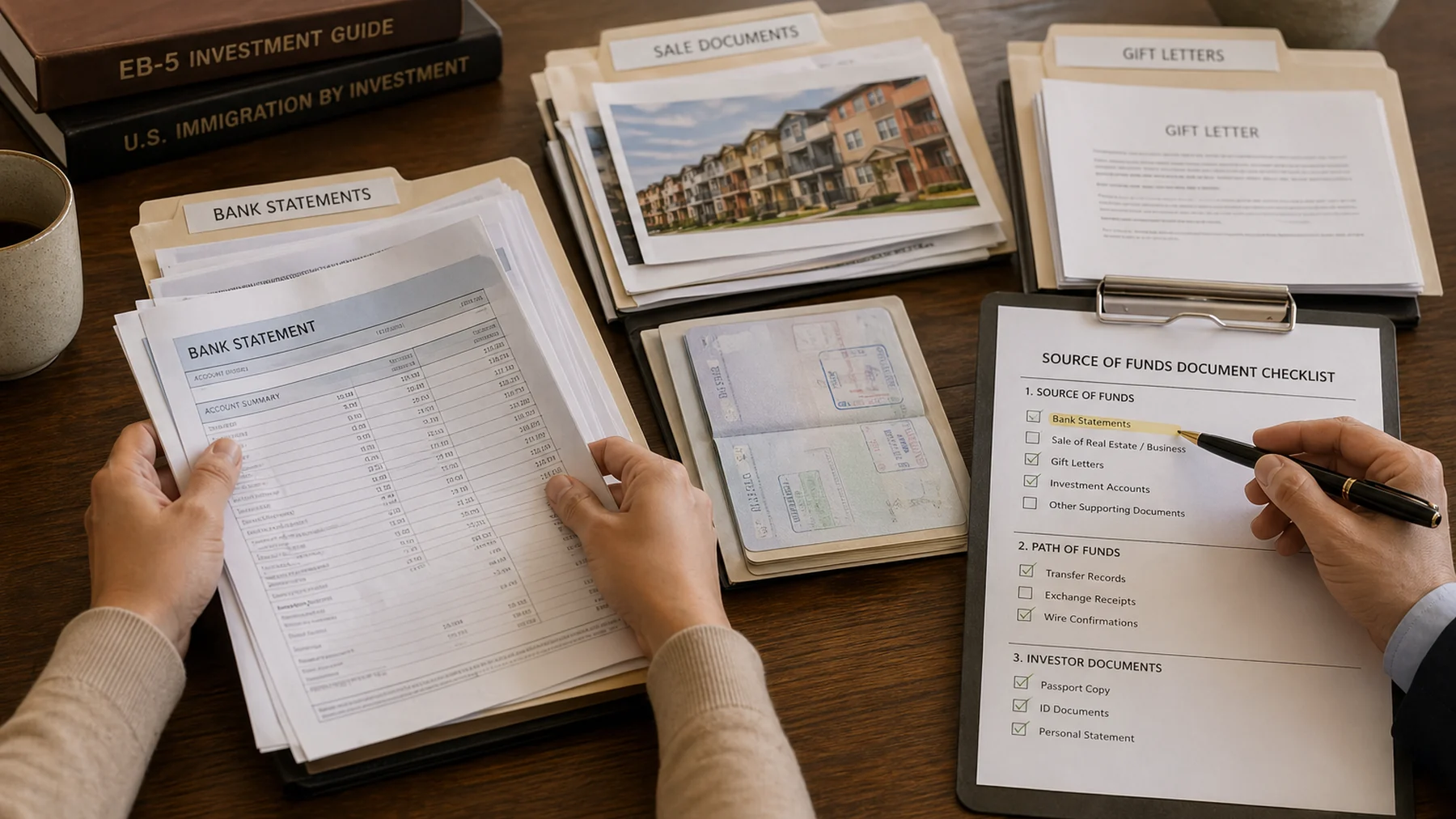
The single biggest RFE driver.
USCIS scrutiny of lawful source of funds is the most common cause of Requests for Evidence on I-526E petitions. Start gathering documentation early.
Typical documentation
- 5 years of personal and business tax returns
- Bank statements tracing the investment funds
- Property sale records (deeds, closing statements, title transfers)
- Business ownership documents (incorporation, shareholding)
- Gift affidavits where applicable (common for Indian investors)
- Inheritance documents (probate, wills) where applicable
- Currency conversion and international wire records
Questions, answered.
What is the total timeline from inquiry to unconditional green card?
Roughly 5–8 years, with most of the variability driven by USCIS adjudication times and country of chargeability. Week 0 to subscription is typically 8 weeks. I-526E approval under RIA typically runs 12–36 months. Conditional residency lasts 2 years. I-829 adjudication adds 12–36 months more.
What is the minimum investment amount?
$800,000 for investments into Targeted Employment Areas (rural or high-unemployment). $1,050,000 for standard investments. Plus administrative, legal, and immigration fees, which typically run $50,000–$90,000 all-in.
Can my family be included?
Yes. The principal investor's spouse and unmarried children under 21 are included as derivative applicants on the same petition and receive conditional green cards alongside the principal. Children who age out (turn 21 during processing) may retain protection under the Child Status Protection Act — consult your immigration attorney.
Do Fremont Developers' projects qualify for TEA?
Our Velora Dos Palos and Golden Years Chowchilla projects sit in rural-designated counties and qualify for the $800,000 TEA threshold. Capitol 101 is evaluated for high-unemployment census-tract TEA status at the time of filing. TEA status is confirmed by your immigration attorney using current federal unemployment data.
Do I need an immigration attorney?
Yes, strongly. Fremont Developers is not a law firm and does not prepare I-526E or I-829 petitions. We work with a short list of qualified EB-5 immigration firms and will provide introductions. All petition decisions are made by USCIS.
How long do petitions take by country?
RIA reserved set-aside visas for rural TEA (20%), high-unemployment TEA (10%), and infrastructure (2%) categories. Rural set-aside investors from historically backlogged countries (India, China, Vietnam) have seen meaningfully shorter adjudication times since 2023. Actual priority dates shift monthly — consult the State Department Visa Bulletin.
What is the difference between I-526E and I-829?
I-526E is the initial petition filed after investment, requesting conditional permanent residency. I-829 is filed during the 90-day window before the 2-year conditional GC expires, requesting removal of conditions based on sustained investment and job creation. I-829 approval yields an unconditional green card.
Can I get my investment back?
EB-5 capital must remain at risk until after I-829 approval — typically 5+ years. After conditions are removed, distributions and capital recovery follow the project's exit timeline. Capital recovery is not guaranteed; EB-5 investments are speculative and illiquid.
How do I decide between direct and Regional Center?
Most investors choose Regional Center because indirect and induced jobs count toward the 10-jobs-per-investor requirement, substantially easing I-829 condition removal. Direct investment fits investors with a specific operational interest in a single enterprise and comfort with direct-W-2-jobs-only accounting.
Fremont Developers is not a law firm and does not provide legal or immigration advice. All immigration decisions are made by U.S. Citizenship and Immigration Services (USCIS). We strongly recommend engaging a qualified immigration attorney before subscribing to any EB-5 offering. We will provide introductions to immigration counsel upon request.
Tell us your situation.
We respond within one business day. Fields marked as required.
Fremont Developers is not a law firm and does not provide legal or immigration advice. All immigration decisions are made by U.S. Citizenship and Immigration Services (USCIS). Investors are strongly encouraged to engage qualified immigration counsel and a tax advisor. Approval of an I-526E petition does not guarantee conditional permanent residency, and approval of an I-829 petition does not guarantee removal of conditions. EB-5 investments are illiquid and speculative. This website does not constitute an offer to sell or a solicitation of an offer to buy any securities. Any such offer or solicitation will be made only by means of a Private Placement Memorandum delivered to qualified investors. Past performance is not indicative of future results.