
Qualified Opportunity Zones Explained: A Bay Area Investor's Guide to 2026
A practical 2026 guide to Qualified Opportunity Zone investing in the Bay Area — current tax benefits, how the 10-year hold works, California conformity issues, and how to identify qualifying projects.

What Qualified Opportunity Zones actually are
The Qualified Opportunity Zone program was created in Subchapter Z of the Internal Revenue Code by the Tax Cuts and Jobs Act of 2017. It is, at its core, a tax-incentive machine built to steer private capital into a set of census tracts that state governors designated as economically distressed. Investors who realize a capital gain from any source — stock sale, business sale, crypto disposition, real estate exit — can reinvest that gain into a Qualified Opportunity Fund (QOF), which in turn invests in qualifying property or businesses inside a designated zone. In exchange, federal tax law gives the investor three things: deferral of the original gain, reduction of that deferred gain in some cases, and — the big one — a complete elimination of federal capital gains tax on the appreciation of the QOF investment itself, provided the investment is held at least ten years.
The program is, on paper, elegant. The first-order effect is a tax benefit. The second-order effect is a reallocation of private capital toward neighborhoods that conventional real estate equity rarely touches. Whether that second effect has materialized everywhere is a separate policy debate. For an investor, the practical question in 2026 is narrower: how do the benefits actually work today, what has changed since 2017, and what should I look for in a real QOZ investment?
The three tax benefits — defer, reduce, eliminate
The three benefits work sequentially and only the third one remains fully intact in 2026 for new investments.
Defer. When you realize a capital gain, you have 180 days from the date of realization to reinvest the gain amount into a QOF. The gain you roll in is deferred — meaning you don't pay federal tax on it — until the earlier of (a) a disposition of the QOF interest or (b) the statutory recognition date, which under current law is December 31, 2026 for investments made before that date. For investments made today under the program as currently enacted, the deferral runs until that statutory recognition date.
Reduce. The original 2017 program offered a 10% basis step-up for QOF interests held five years, and an additional 5% step-up at seven years, which would have reduced the amount of the deferred gain ultimately recognized. Those step-ups required the seven-year hold to complete by the recognition date. By 2026, the windows to capture those step-ups for new investments have largely closed. Most investors entering the program today should treat the "reduce" benefit as effectively phased out and plan around the "defer" and "eliminate" benefits only.
Eliminate. If you hold your QOF interest for at least ten years and elect to step the basis up to fair market value when you dispose of it, any appreciation of the QOF investment itself is excluded from federal capital gains tax. This is the benefit that has always done the heavy lifting. On a project that triples in value over a decade, the elimination of federal capital gains tax on that tripled appreciation is the difference between an ordinary real estate return and a post-tax return that competes with nearly anything else in the private markets.
The ten-year hold is where QOZ earns its reputation. Every other tax-sheltered real estate structure taxes the exit. QOZ, for investors who can commit for a decade, does not.
How the 180-day reinvestment window works
The 180-day window is the tightest and most-misunderstood deadline in the program. Count begins on the date of the capital gain realization. For a stock sold on a public exchange, that's the trade date. For a business sale, that's the closing date. For a partnership K-1 gain, the rule is softer — you can elect to begin the 180 days from the last day of the partnership tax year, which in practice gives many LP investors until June of the following year to reinvest gains allocated on a December K-1.
Within that window, the cash or equivalent has to land in a QOF — not in escrow, not pending, not committed. The QOF is itself required to deploy 90% of its assets into qualified opportunity zone property within the time frames prescribed by the regulations. Both sides of that chain have compliance mechanics that matter, and the difference between a properly structured QOF and an improperly structured one is the difference between a ten-year tax benefit and a ten-year tax audit.
2026 status — what's changed since 2017
The program as originally enacted was scheduled to allow new investments through December 31, 2026. Congress has been actively considering extensions and modifications — a so-called QOZ 2.0 — and at the time of writing (early 2026), extension legislation has been in and out of committee markups but the final disposition is uncertain. Investors should verify with tax counsel the current status of any extension before assuming benefits are available for post-2026 gains.
What has clearly changed since the program's launch: the IRS has issued detailed regulations that clarified many of the ambiguities in the original statute (working capital safe harbors, substantial improvement tests, and zone re-designation rules). The 10% and 15% basis step-ups are effectively no longer available for new investments. Zone designations themselves have not been rolled over as some observers expected, which means the list of qualifying census tracts in 2026 is the same set governors identified in 2018. A handful of those tracts have gentrified beyond any reasonable reading of "economically distressed" — a flaw in the design that Congress may or may not correct — and a larger set remain genuinely underdeveloped markets.
California's non-conformity problem
This is the piece most broadly overlooked. California did not conform to the federal QOZ provisions in its state tax code. For a California-resident investor, the federal tax benefits of a QOZ investment — deferral, reduction, and the ten-year elimination — apply at the federal level. At the state level, California treats the deferred gain as currently taxable and treats the eventual sale of the QOF interest as a normal capital gain realization. The full headline benefit of "zero tax on the ten-year appreciation" becomes "zero federal tax on the ten-year appreciation, full California tax on the ten-year appreciation."
California's top marginal state rate on long-term capital gains is 13.3%. On a $1 million appreciation, that is $133,000 of state tax that a QOZ investment does not shield you from. This is a meaningful dilution of the program's headline math for California investors and something a competent tax advisor will model before you sign a subscription agreement. It does not make QOZ a bad deal — the federal benefit remains large — but it does change the comparison against other tax-efficient structures like 1031 exchanges or installment sales.
A California investor evaluating a California QOZ project is buying a federal benefit, not a combined federal-and-state benefit. Model both tax layers before you commit.
What makes a Bay Area QOZ project compelling
The tax benefit only matters if the underlying real estate deal produces the appreciation that triggers it. A QOZ investment that breaks even over ten years delivers zero federal capital gains tax on zero appreciation — which is exactly zero benefit. The deal, as a real estate deal, has to work.
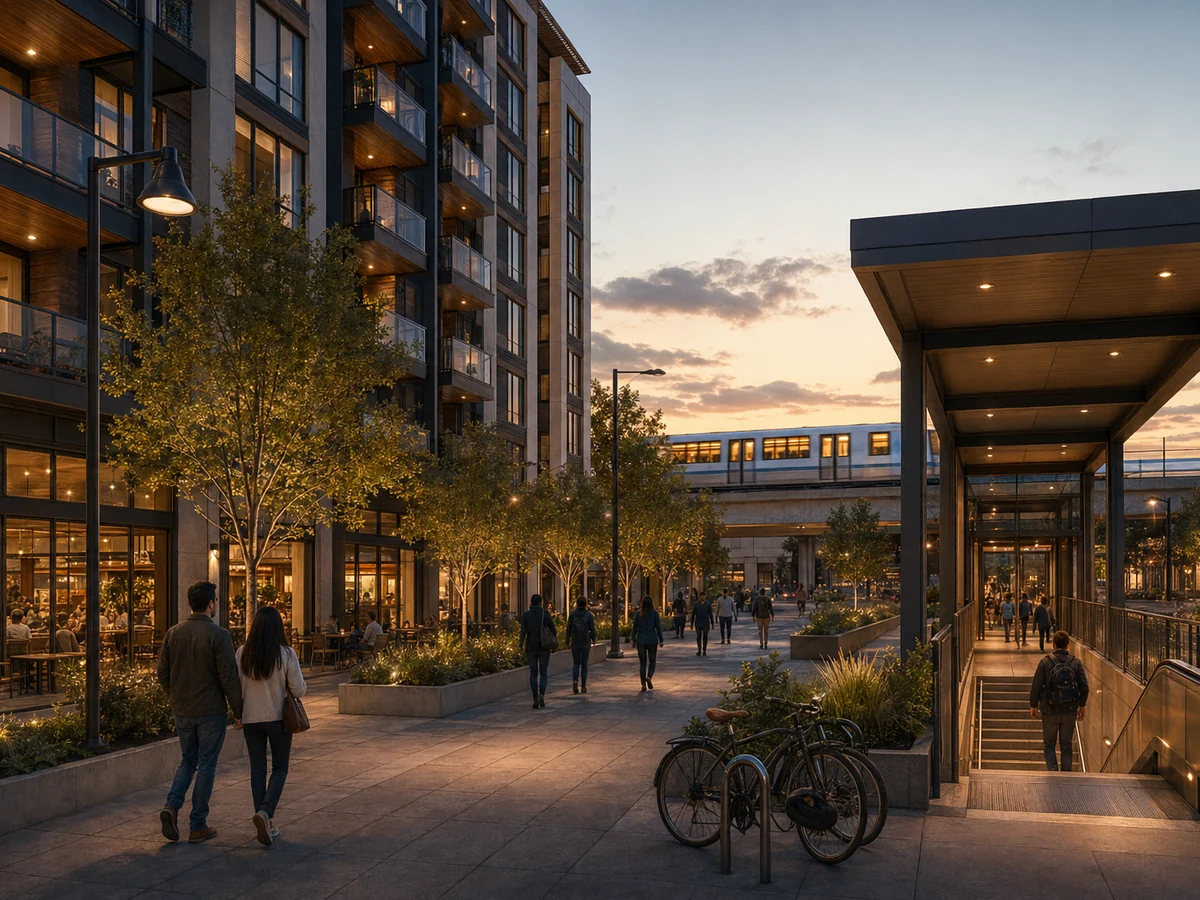
The Bay Area is unusual among QOZ geographies because several designated tracts sit inside or adjacent to the most supply-constrained rental markets in the United States. Downtown Fremont, parts of East Oakland, portions of Richmond, and pockets of the South Bay contain QOZ tracts where rents, employment density, and public-transit infrastructure are already in place at levels that many non-Bay-Area QOZ markets are trying to build toward from scratch. The underlying real estate bet in a Fremont QOZ is not "this neighborhood will gentrify." The bet is "this neighborhood is already economically active, and the QOZ wrapper happens to be layered on top of a site that would pencil as a new-construction apartment deal on its own merits."
Our own active QOZ offering sits in exactly that category. Capitol 101 is a 126-unit, 14,000 square-foot mixed-use project at 3411 Capitol Ave in downtown Fremont, three minutes from BART, with a stabilized NOI of $7.57M and a yield on cost of approximately 7.69%. The site sits inside a designated QOZ tract. The project would pencil as a Bay Area multi-family development without the QOZ benefit; the QOZ benefit is additive, not the thesis.
How to evaluate a QOF
Six questions separate a real QOF from a marketing package.
- Is the zone currently designated? Not every census tract labeled as a QOZ in 2018 remains one by every definition in 2026. Verify the tract number.
- Is the underlying property a "Qualified Opportunity Zone Business Property"? This involves a substantial-improvement test (for existing buildings) or an original-use test (for new construction).
- Does the sponsor operate the asset, or only promote it? Many QOFs are distribution layers raising capital for projects they do not control. The difference matters — your ten-year capital stack is only as stable as the operator running the building.
- What is the sponsor's experience in the specific product type? A ground-up apartment QOZ and a retail-repositioning QOZ are different businesses. Match the sponsor's track record to the asset class.
- How is the capital stack structured? Fund-of-fund layers and multi-level management fees can erode the post-tax return to a point where the QOZ benefit is effectively consumed by intermediaries.
- What is the exit plan at year ten? A true ten-year hold requires a capital partner and operator aligned with that timeline. Many QOFs include optional earlier exits that compromise the ten-year benefit.
The 10-year hold — why it's the real benefit
Most QOZ marketing leads with deferral. Deferral is real, but for an investor who would have held stock for another decade anyway, the deferral is a timing benefit worth a few hundred basis points of annualized value at most. The elimination benefit is different. On a project that appreciates from $100 to $250 over ten years, eliminating federal capital gains tax on $150 of appreciation is — at a 23.8% federal long-term rate plus net investment income tax — roughly $36 per $100 of initial investment retained as after-tax value. That is the number that moves portfolios.
The ten-year benefit also forces a discipline that improves the real estate outcome. A QOZ investor cannot realistically exit at year three or year five without sacrificing the benefit that drove the investment in the first place. That aligns the QOZ investor with a development timeline — site acquisition, entitlement, construction, lease-up, stabilization, refinance, operation — that is natural for real estate anyway. Mismatched-timeline money is the single most common cause of real estate friction; QOZ by design pre-selects for matched-timeline money.
Risks investors underestimate
The two risks most often underestimated are legislative risk and illiquidity risk. Legislative risk: the QOZ program exists only because Congress wrote it into the code. Congress can change it. Future legislation could alter the ten-year elimination, recharacterize QOF interests, or reduce the scope of qualifying activities. The language of "as currently enacted" should appear on every QOZ memo you read, and a mature investor plans around the possibility that the rules will move. Illiquidity: a ten-year hold is a ten-year hold. QOF interests are not publicly traded, secondary markets are thin, and early exit — even when contractually permitted — typically means forfeiting the benefit that rationalized the investment.
None of this is tax advice. Your specific benefit depends on your gain basis, your state of residence, your holding period, and dozens of facts a CPA needs to see. Fremont Developers structures QOZ investments through affiliated issuing entities under Regulation D Rule 506(c) and makes its offering documents available only to verified accredited investors. If you'd like to see how Capitol 101 is structured as a QOZ, or you want to understand what a ten-year Fremont real estate position looks like inside your broader portfolio, a conversation is the right way to start.
For the investment vehicle details, see the Capitol 101 QOZ page; for our full investment firm, our investment overview is the starting point.
Related

Cap Rate vs Yield on Cost: How Developers Actually Price New Construction

Downtown Fremont in 2030: The Development Pipeline You Should Know About
Why Fremont's BART-Adjacent Development Is Undervalued Right Now
See how Capitol 101 works as a QOZ investment.
126 luxury apartments plus 14,000 sq ft of retail, inside a designated QOZ tract in downtown Fremont. Accredited investor documentation available on request.